6 Ways AI Resume Screening Reduces Time-to-Hire
1. Eliminates the First-Pass Bottleneck
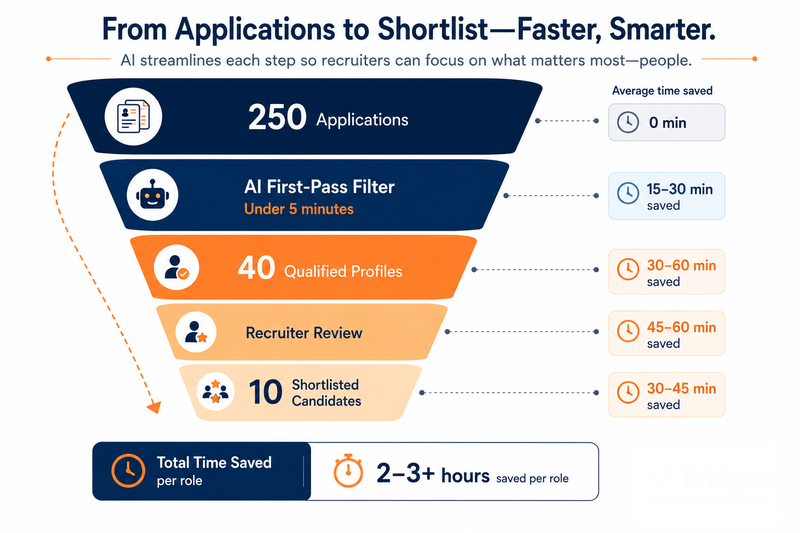
Manual first-pass screening is consistently one of the most time-intensive, low-value activities in any recruiting operation. For a role receiving 200 or more applications, a recruiter spending even five minutes per resume is committing more than 16 hours of focused review time before a single qualified candidate reaches a hiring manager. When multiple open roles are running concurrently, this bottleneck compounds quickly into hiring delays that affect business outcomes well beyond the talent team.
AI tools reduce the first-pass bottleneck to near zero. The system surfaces the top 10 to 20 percent of candidates in minutes, providing recruiters with a prioritized queue rather than an undifferentiated pile.
Data from 2026 reports, including insights compiled from SHRM and Deloitte, indicate that AI-assisted candidate screening reduces total time-to-hire by up to 50% without compromising the quality of hires or retention. Furthermore, adopting automated screening workflows accelerates the recruitment pipeline by focusing human effort on high-value engagement rather than manual sorting.
For more data on this trend, visit RecruitAI Suite
2. Applies Criteria Consistently Across Every Application
Human reviewers are inconsistent, and the research on why is unambiguous. Cognitive load, time pressure, and unconscious pattern recognition all affect judgment in ways that individual reviewers rarely notice.
Research published in Organizational Behavior and Human Decision Processes found that candidates reviewed later in a batch session are rated significantly lower than equally qualified candidates reviewed earlier, even by the same experienced recruiter reviewing the same criteria.
AI systems apply identical criteria to application number one and application number two hundred and forty-seven, regardless of the time, how many resumes have already been reviewed, or how closely the candidate's background matches the reviewer's own career path.
This consistency does not eliminate bias from the hiring process. Bias can still enter through the criteria themselves, through flawed model training data, or through downstream decisions. What consistency does eliminate is one of the most pervasive and least auditable sources of variance in candidate evaluation. Audit trails and model validation are still essential, but consistency in the application of criteria is itself a meaningful quality improvement over purely manual review at scale.
3. Surfaces Non-Traditional Candidates That Human Screeners Miss
One of the more counterintuitive advantages of well-configured AI screening is its ability to surface strong candidates from non-traditional backgrounds that a human screener might deprioritize due to habit or pattern recognition.
This includes career changers with directly transferable skill sets, candidates from smaller or less recognizable companies operating in the same industry, and candidates without specific degree credentials applying for roles that do not genuinely require them.
This benefit only materializes when the tool is configured around demonstrated competencies and outcomes rather than credential proxies.
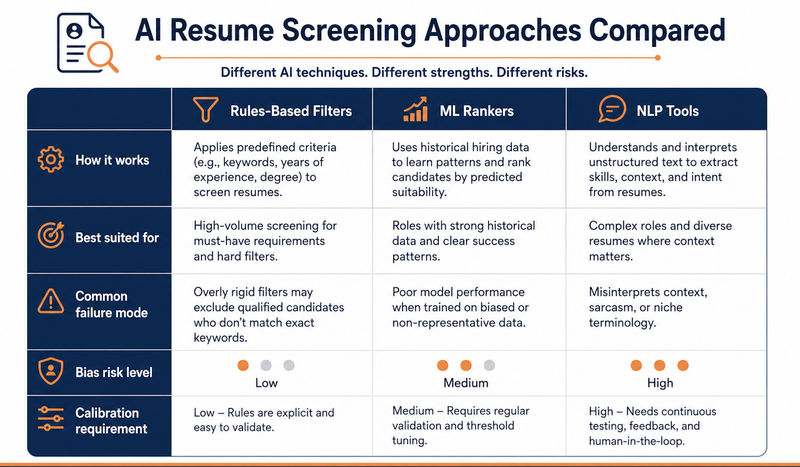
An NLP tool asked to evaluate what a candidate actually did, rather than where they worked or what their job title was, can find strong matches that keyword-based filters would never surface. The result is a broader, more competitive shortlist and a stronger pipeline of candidates who would have been invisible to the previous process.
4. Frees Recruiters for High-Judgment Work
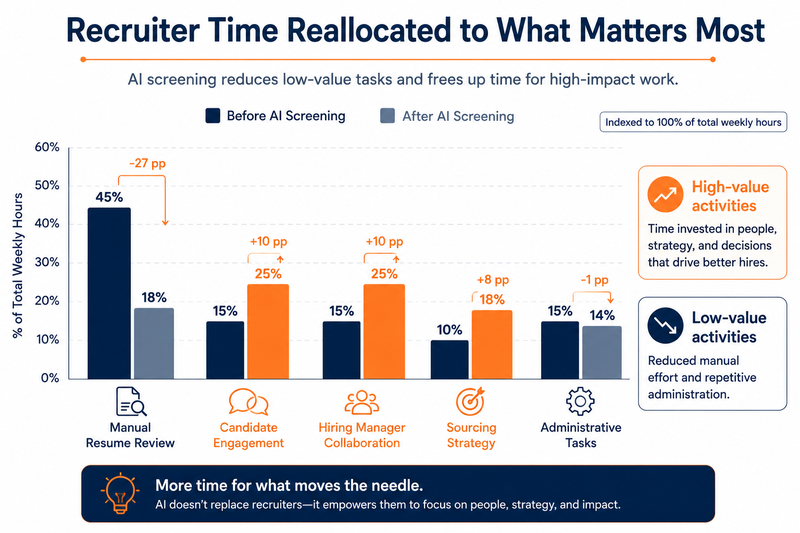
Every hour a recruiter spends manually sorting through unqualified applications is an hour not spent building relationships with strong candidates, briefing hiring managers on what the market actually looks like, or improving the interview experience for people who are already in the process.
These higher-value activities are the ones that directly affect offer acceptance rates, candidate quality, and the speed at which critical roles get filled.
AI screening creates the capacity for this shift by handling volume at the top of the funnel. Teams that have implemented AI-assisted screening consistently report that recruiter time reallocates toward candidate engagement, sourcing strategy, and hiring manager alignment rather than administrative triage.
The quality of those conversations improves because recruiters arrive prepared and focused, rather than already depleted from hours of manual review.
5. Enables Structured, Repeatable Calibration Across Roles
One of the persistent challenges in recruiting is that hiring criteria for the same role often drift among hiring managers, teams, and over time as business priorities shift.
AI screening creates a documented, editable set of criteria for each role that can be reviewed, tested against actual hire performance, and refined over successive hiring cycles. This turns screening from an informal, subjective judgment call into a structured process with a built-in feedback loop.
When a candidate is successfully hired, the candidate's characteristics can be used to validate or adjust the model's weighting. When a hire underperforms or churns quickly, the signal can be traced back to the screening criteria, identifying where the misalignment originated.
Over time, this feedback loop produces progressively sharper shortlists. Manual screening processes rarely generate this kind of structured learning because the criteria exist primarily in individual reviewers' heads rather than in a system that can be interrogated and improved.
6. Reduces Bias Exposure at the Highest-Volume Decision Point
The first-pass screening stage is the highest-volume decision point in any hiring funnel, which means it is also the stage where bias has the greatest cumulative effect on outcomes.
When a human reviewer is processing 200 applications, even a subtle pattern of deprioritizing candidates with unfamiliar names, unconventional career paths, or non-traditional educational backgrounds can exclude a significant portion of the qualified candidate pool before any structured evaluation has taken place.
AI systems, when properly audited and maintained, apply criteria without being influenced by name, perceived gender, age, or other demographic signals that should not affect a hiring decision.
This does not mean AI is bias-free. Models trained on historical data can encode past biases at scale, which is why bias auditing and ongoing validation are non-negotiable for any responsible deployment. The important distinction is that AI bias is auditable, adjustable, and systematically testable in ways that individual human judgment at volume is not.
 Regine CyrilleHuman Resource19 Jun 2026