Asynchronous vs. Live Video Interviews: 4 Questions That Decide Which to Use
 Meli ImeldaHuman Resource12 Jul 2026
Recruiters closed 122% more hires per person between 2022 and 2025, even as the average recruiting team shrank by more than half, according to Greenhouse's 2026 Benchmark Report. No recruiting team gets that kind of output by adding more live phone screens. But most teams are not running zero live interviews either. They just have not written down the rule for when one format switches to the other.
That is the question that matters behind "pre-recorded or live." It is not about which format is better.
A 2025 peer-reviewed study in the International Journal of Selection and Assessment found that pre-recorded video interviews perform about as well as live ones at predicting job performance, as long as the questions and scoring are standardized. The format is not the variable that matters most. The situation is.
Why This Decision Deserves a Rule, Not a Habit
Most hiring teams pick a format out of habit, not because it fits. A team that has always done phone screens defaults to live video. A team that adopted a screening tool for one high-volume role starts using pre-recorded video for everything, including the final round for a director-level hire.
Both defaults break down under the wrong conditions. Pre-recorded video at the final round for a senior hire skips the moment a candidate needs to ask hard questions before accepting an offer. Live video at the top of a 300-applicant funnel burns hours a recruiter does not have and produces wildly inconsistent scoring, since no two live conversations follow the exact same script.
The fix is not picking a favorite format. It is matching the format to four things: how many candidates you are screening, what stage of the funnel you are in, what the role actually demands, and how fast you need to move.
Here is how to work through each one:
1. How Many Candidates Are You Screening?
Volume is the clearest signal. If you are screening more than 20 or 30 candidates for a single opening, a pre-recorded round almost always makes sense before any live conversation happens. A recruiter can review a set of recorded answers in a few minutes each, compared to 30 to 45 minutes for a live phone or video screen.
This is the everyday reality for staffing agencies and BPO teams filling dozens of seats a week across multiple clients. At that volume, a pre-recorded first round is not a shortcut. It is the only way to give every applicant a fair look, rather than reviewing only the first 20 resumes that came in.
On the other end, an SMB or early-stage startup hiring for a single specialized role with 8 applicants does not need a pre-recorded layer at all. Jump straight to a live conversation. Adding a recorded round just adds a day of waiting for both sides with no screening benefit at that volume.
Takeaway: Below roughly 15-20 applicants, go live from the start. Above that, the screen with the pre-recorded video is first.
2. What Stage of the Funnel Is This?
The same role can, and often should, use both formats at different points. Early screens exist to narrow a large pool to a shortlist worthy of a recruiter's full attention. That is exactly what pre-recorded video is built for: consistent questions, consistent scoring, reviewed on the recruiter's own schedule.
Final rounds exist for a different reason. They confirm fit, answer the candidate's questions, and give a hiring manager a chance to hear how someone thinks in the moment, not just how they answer when they have time to prepare. Skipping a live conversation at this stage is one of the more common ways teams increase decline rates, since candidates who never spoke to a real person before an offer is made are more likely to walk away.
This matters even more for senior and leadership roles. SHRM's 2026 Recruiting Executives Benchmarking report found that senior leadership searches typically run 60 to 90 days, with 12 to 20 of those days specifically focused on fit and leadership assessment, most of which occurs in live conversations that a recording cannot replace.
Takeaway: Use pre-recorded video to narrow the field, and reserve at least one live conversation before any offer goes out, no matter how strong the recording was.
3. What Does the Role Require?
Some jobs are evaluated well by a prepared, structured answer. Others are not. A technical writer, a data analyst, or an entry-level operations hire can be assessed fairly through pre-recorded questions that mirror the kind of structured thinking the job actually requires.
A role built around handling an upset customer on the spot, leading a team through a live incident, or selling to a skeptical buyer is a different case. Those jobs live or die on how someone handles pressure without a script, and a pre-recorded answer cannot show you that. For roles like this, move to a live conversation earlier in the process, even if it means doing it with a slightly larger group than you would for a role you can screen asynchronously.
There is a trust dimension here, too. When Greenhouse surveyed almost 3,000 job seekers for its 2026 Candidate AI Interview Report, the single most common reason candidates gave for abandoning a hiring process was landing on a pre-recorded interview scored by AI with no human present, cited by 33% of the candidates who walked away. For high-stakes or senior roles, where a candidate is more likely to have other offers and more room to walk away, an all-recorded process can read as a sign that the company does not value the hire enough to put a person on the call.
Takeaway: Let the role's demands, not convenience, determine how early in the process a live conversation enters the process.
4. How Fast Do You Need to Move, and Who Needs to Weigh In?
Pre-recorded video wins on coordination. If three people need to evaluate a candidate and they are spread across time zones, a recording lets each of them review on their own schedule instead of everyone trying to find one overlapping hour. This is a clear advantage for enterprise teams hiring across regions, where scheduling a single live panel can take longer than the interview itself.
Live video wins when speed depends on a single decision-maker who is available now. A founder at a startup hiring their fifth employee does not need to wait for a recording to be submitted and reviewed. A 20-minute call today beats a recording tomorrow when only one person needs to say yes.
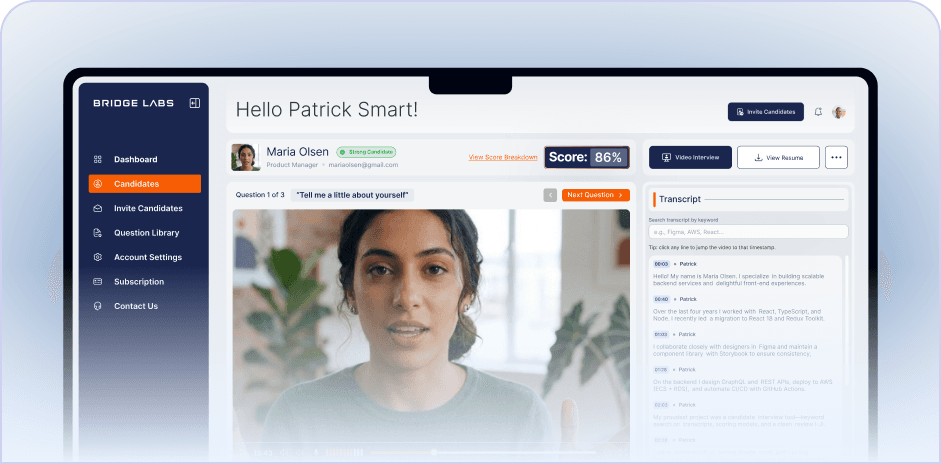
A video screening platform that supports both formats in one place removes the need to pick one tool for volume and a separate one for live rounds, which keeps the switch from pre-recorded to live from feeling like a break in the process for the candidate.
Takeaway: match the format to how many people need to weigh in and how quickly a decision can actually be made, not just to overall hiring urgency.
What Not to Do
- Do not treat it as an all-or-nothing choice. The strongest processes use pre-recorded video for volume and live video for judgment, rather than a single format across the entire pipeline.
- Do not run a fully pre-recorded process through to offer. Even one short live conversation before an offer reduces decline rates and gives candidates a chance to ask questions a script cannot answer.
- Do not run live interviews on a 200-candidate funnel because it feels more personal. Without structure, live interviews produce more inconsistent scoring than a well-built pre-recorded round, not less.
- Do not skip structure just because a format feels more human. An unscored live interview is just as unreliable as a pre-recorded interview with no rubric. The format is not what makes an interview fair. The structure is.
- Do not switch formats on candidates without saying so. If someone moves from a pre-recorded round to a live final, a short note explaining why builds trust instead of confusion.
Making the Call
Pull up your current hiring process for one open role and mark where pre-recorded video is used and where live video is used. Then check each stage against the four questions above: volume, funnel stage, role demands, and speed.
Where the format does not match the situation, that is the stage to fix first. Most teams do not need a new tool to get this right. They need a written rule for when one format hands off to the other, so the choice stops being a habit and starts being a decision.
FAQs
Can you switch a candidate from pre-recorded to live video partway through the process?
Yes, and for most roles above 15 to 20 applicants, that is exactly how the process should work. Just tell the candidate why the format is changing. A short line like "you're moving to a live conversation with the hiring manager" reads as a sign of progress rather than a change in an unexplained process.
Is one format more prone to bias than the other?
Neither format is inherently fairer. A pre-recorded interview with a clear rubric and an unscored live interview with no structure can produce very different levels of bias, and the unscored live conversation is usually worse. The format matters less than whether every candidate is evaluated against the same written standard.
Do candidates actually prefer live interviews over pre-recorded ones?
Often, yes, especially later in the process when they want to ask their own questions. But preference is not the only factor. A well-run pre-recorded round with a clear deadline and an explanation of how it will be used can perform nearly as well on candidate satisfaction as a live screen, particularly at the top of a large funnel, where the alternative is a long wait for any response at all.
What is a reasonable cutoff for switching from pre-recorded to live screening?
Somewhere around 15 to 20 applicants per role is a workable starting line. Below that, a recruiter can reasonably reach every candidate live without a backlog. Above it, a pre-recorded round becomes the more consistent and more scalable way to give everyone a fair first look.
Latest From Our Blog
Discover fresh insights, trends, and tips on tech talent and offshore development. Stay informed with our latest updates