5 Rules for Scaling Pre-Recorded Interviews Without Losing Candidates
 Meli ImeldaHuman Resource09 Jul 2026
The average job posting drew 257.6 applications in 2025, up from 207.2 the year before, according to HR Dive's coverage of Employ's 2025 Hiring Benchmarks report. That is not a rare spike. It is the new average week for anyone hiring at volume in 2026.
Application volumes are surging while hiring teams are being asked to do more, faster, with fewer mistakes. Phone screens do not scale against that math. Pre-recorded video interviews, sometimes called asynchronous interviews, are one of the few formats that do.
But scaling the format is not the same as scaling it well. Here is what separates recruiting teams that use pre-recorded interviews to move faster from teams that just move candidates further away.
Why Pre-Recorded Interviews Are Now the Default at Volume
The average time to fill a role sits at 42 days, according to LinkedIn's 2026 Talent Velocity Advantage Report. That number hides a wide gap by company size. Employ's benchmark data found that small and midsize companies took an average of 83.5 days to fill a role in 2025, compared to 51.7 days for enterprise teams, per the same HR Dive report.
That gap is exactly why pre-recorded interviews matter more for leaner teams. An SMB or startup without a dedicated screening function cannot absorb 257 applications per role with live phone screens. Neither can an enterprise team run dozens of open requisitions across regions. The format closes the gap either way, but only if it is built with the same discipline as any other stage in the funnel.
The math is compelling. A recruiter can review a candidate's recorded answers in a few minutes instead of spending 30 to 45 minutes on a live phone screen, which is why the format has become standard for any team filling more than a handful of roles at once.
But speed is not the only thing candidates are watching. Only 26% of job applicants trust that AI will evaluate them fairly, according to a 2025 Gartner survey. And ghosting is already a serious problem: 53% of job seekers say they were ghosted by an employer in the past year, up from 38% in 2024, per Criteria Corp's 2026 Candidate Experience Report.
Put those numbers together, and the risk is clear. A pre-recorded interview process that feels like a black box, one where candidates record answers and never hear a person's voice again, will make both problems worse. How you run the format matters as much as whether you use it. The five rules below cover the full lifecycle: designing the interview, scoring it consistently, communicating with candidates, keeping a human in the loop, and measuring whether any of it is actually working.
1. Design a Short, Role-Specific Question Set
Long question sets are the single biggest driver of candidate drop-off. Every extra question adds friction, and candidates who are applying to multiple roles will simply abandon the one that takes the longest. Four to five focused questions are usually enough to tell whether someone should move to the next round.
Question count is only half of it. The bigger mistake is reusing a generic bank of questions across every open role. A question written for a sales position tells you nothing useful about a data analyst, and generic prompts like "tell me about yourself" produce polished, rehearsed non-answers that get recycled across dozens of applications.
Write each question against a specific competency the role actually requires: the ability to explain a technical tradeoff to a non-technical stakeholder, or the ability to de-escalate an upset customer without a supervisor stepping in. If a question does not map to something you would actually reject or advance a candidate over, cut it. For high-volume roles at BPO and staffing agency teams, this discipline matters even more, since the same question set often runs across hundreds of candidates a week.
Takeaway: Five sharp, role-specific questions will outperform ten generic ones every time.
2. Build and Tune the Scoring Rubric Before You Turn On Volume
The biggest mistake in scaling pre-recorded interviews is turning on high volume before recruiters agree on what constitutes a strong answer. Without a shared rubric, two recruiters watching the same response will score it differently, and neither will be able to explain why. That inconsistency compounds quickly once a rubric is applied to thousands of candidates rather than dozens.
Write the rubric before the first batch goes out: what does a 1 look like? What does a 5 look like? For each individual question, not just the interview as a whole. Then run a short tuning session with two or three recruiters scoring the same handful of sample responses side by side. Where scores diverge, rewrite the rubric language until they do not.
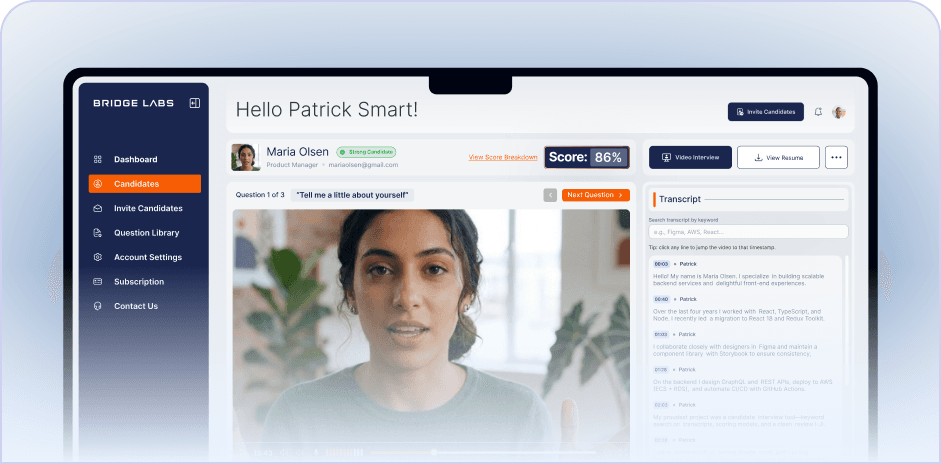
Tools that build the rubric directly into the review screen, like Bridge Labs' video screening platform, make this step harder to skip because scoring happens right next to the recording instead of in a separate spreadsheet that recruiters forget to update.
Takeaway: tune the rubric with two or three recruiters before the first batch goes out, not after candidates are already mid-funnel.
3. Set Clear Deadlines and Tell Candidates How Their Answers Will Be Used
Vague windows like "sometime this week" lead candidates to deprioritize your interview in favor of one with a firm date. Give an exact deadline, send one reminder before it hits, and close the link when it passes. This matters most for staffing agencies and BPO teams filling dozens of seats a week, where a loose deadline on one requisition backs up the entire pipeline behind it.
Deadlines solve timing, but they do not solve trust. Given that only about a quarter of applicants trust AI to evaluate them fairly, silence about your process reads as evasive. A short line before the interview starts, such as "a recruiter reviews every response, and any AI scoring is used to help prioritize, not to reject automatically," changes how candidates experience the format.
This is not a compliance footnote. It is the difference between a candidate who finishes the interview feeling respected and one who finishes feeling tested by a system they cannot see. For startup teams building an employer brand from scratch, that first impression carries even more weight since there is no long hiring history for candidates to weigh it against.
Takeaway: a clear deadline and a one-sentence explanation of the process cost almost nothing and buy a lot of trust.
4. Keep One Live Checkpoint Before Any Offer
Pre-recorded interviews are a screening tool, not a replacement for meeting the person you are about to hire. Teams that run a fully one-way process from application to offer see higher decline rates, because candidates never get a chance to ask their own questions or hear a person's voice on the other end.
One short live conversation, even 15 minutes, before an offer goes out, closes that gap. It also gives hiring managers a chance to confirm what the recording already suggested, catch anything a rubric might miss, and answer questions about the role that a script cannot anticipate. For enterprise teams running interviews across multiple regions and time zones, this checkpoint can be the only live touchpoint in the process, making it worth protecting rather than cutting for speed.
Takeaway: pre-recorded interviews should narrow the pool, not make the final call alone.
5. Track Completion Rate and Audit Outcomes by Group
Most teams track how many candidates start a pre-recorded interview, but not how many finish it. Completion rate is the earliest signal that something in the process, question count, deadline, or instructions, is pushing candidates out before you ever see them. Set a baseline in the first month and check it weekly. A drop of more than a few points after a change, a new question, or a shorter deadline warrants immediate investigation. Reporting features built into a video screening platform can surface this automatically, rather than requiring a manual export every week.
The completion rate tells you whether the process is respectful. It does not tell you if it is fair. Structured scoring reduces bias, but it does not eliminate it automatically. Pull pass-through rates by demographic group every quarter and look for gaps that a rubric alone would not catch, like camera quality, accent, or background noise affecting scores.
This matters more as volume increases. A small bias in a rubric applied to 50 candidates is a problem worth fixing. The same bias applied to thousands of candidates a quarter, which is the reality for many high-volume enterprise and BPO hiring teams, is a pattern that shows up in an EEOC complaint before it shows up in a dashboard.
Takeaway: scale multiplies whatever is already in the process, good or bad, so measure both how candidates experience it and how fairly it treats them.
What Not to Do
- Do not remove every human touchpoint from the process. A pipeline that goes from application to offer without a single live conversation will lose strong candidates who read the silence as disinterest.
- Do not reuse a single generic question set across all roles. A rubric built for a sales role tells you nothing useful about a technical candidate, and generic questions signal to candidates that the role was not thought through.
- Do not skip the deadline reminder. Candidates juggling multiple applications need a nudge, and a single reminder email recovers a meaningful share of near-miss completions.
- Do not let a score decide alone on borderline candidates. Automated scoring is useful for sorting, not for the final call on anyone close to the cutoff. A person should always review the middle of the distribution.
- Do not skip your own test run. Have a colleague go through the interview end-to-end before it goes live. Broken links, unclear instructions, and confusing questions are far more common than teams expect, and candidates will not tell you about them; they will just leave.
Putting This Into Practice
Start with one requisition. Pull up your current pre-recorded interview flow and check it against the five rules above: the question set, the rubric, deadlines and transparency, a live checkpoint, and completion-rate and fairness tracking.
Fix whatever is missing on that one requisition before rolling the changes out everywhere, whether that is a single team at an SMB or dozens of requisitions across an enterprise account. Track completion rate for 30 days and use it as your evidence that the process is actually working, not just moving faster.
FAQs
How many questions should a pre-recorded interview include?
Four to five focused questions are the range that keeps completion rates high while still giving recruiters enough to make a decision. More than that, the drop-off increases sharply.
Do candidates actually dislike this format?
Not inherently. What candidates dislike is silence and unclear expectations. A pre-recorded interview with a clear deadline, a short explanation of the process, and a follow-up regardless of outcome tends to perform well in candidate feedback.
Should AI scoring be fully automated?
No. Use automated scoring to sort and prioritize a large pool, but keep a person reviewing anyone near the cutoff. Given that most candidates are still skeptical of AI evaluation, a fully automated decision poses as much of a trust risk as a fairness risk.
What response window should we give candidates?
Somewhere between three and seven days works for most roles. Shorter windows risk excluding strong candidates who are currently employed and cannot respond the same day. Longer windows tend to reduce urgency and completion rate.
Latest From Our Blog
Discover fresh insights, trends, and tips on tech talent and offshore development. Stay informed with our latest updates