7 Tips for Writing One-Way Interview Questions
 Meli ImeldaHuman Resource02 Jul 2026
One-way video interviews have grown significantly in adoption over the past several years, and with that growth has come a wave of criticism from candidates who find the format impersonal, opaque, and disconnected from how a meaningful hiring conversation should feel. A 2026 report found that 33% of candidates abandoned a job application specifically because it required a one-way video interview, a figure that reflects genuine frustration rather than mere resistance to change.
Much of that frustration is understandable and warrants serious consideration by any hiring team that uses the format. Candidates invest time in preparing and recording their responses without knowing who will watch, how their answers will be evaluated, or whether the process shows any real consideration of their experience. When those concerns are left unaddressed, the one-way interview feels less like a fair first step and more like a filter designed for convenience rather than quality.
What most of that criticism misses, however, is that the format itself is rarely the source of the problem. The more common failure point is the quality of the questions being asked inside it. When a candidate records their responses without any opportunity to ask for clarification, follow up on something they said, or read the room and adjust their approach, the question carries the entire weight of the evaluation. A vague or poorly constructed prompt does not simply produce unhelpful responses. It actively skews results toward candidates who are practiced at performing on camera rather than those who are genuinely qualified for the role.
This is fundamentally a question-design problem, and question-design problems are solvable with the right framework and deliberate attention to how each prompt is constructed before it reaches a single candidate.
What Makes a One-Way Interview Question Work
Before getting into the specific tips, it helps to define what makes a strong one-way interview question.
A strong question:
- Has a clear, unambiguous prompt that does not require follow-up to interpret
- Targets a specific competency, behavior, or skill relevant to the role
- Gives candidates enough scope to show their thinking without being so open-ended that the response is impossible to evaluate
- Produces answers that are meaningfully different between strong and average candidates
A weak question does the opposite. It is so broad that everyone sounds roughly the same. Or it is so narrow that it can be answered with a single rehearsed sentence. Or it requires insider context that only someone already in the role would have.
7 Proven Tips for Writing One-Way Interview Questions Guaranteed to Surface Top Candidates
1. Anchor Every Question to a Specific Competency
Start by listing the three to five competencies the role genuinely requires. Not "communication skills" as a placeholder, but specific, observable things: the ability to explain a technical decision to a non-technical stakeholder, or the ability to manage competing deadlines without escalating every conflict upward.
Write one question per competency. If you cannot trace a question directly back to a specific competency on your list, cut it.
This sounds straightforward, but most one-way interview question sets include at least two or three questions that are essentially vibe checks dressed up as structured prompts. Those questions produce the most subjective responses and the least useful shortlists.
2. Default to Behavioral and Situational Formats
"What is your management style?" is an opinion question. It tells you how a candidate thinks about themselves, not how they actually behave under pressure.
"Tell me about a time you had to give a direct report, critical feedback that they disagreed with. What was the situation, what did you say, and what happened as a result?" is a behavioral question. It requires a specific memory, a real event, not a performance.
Behavioral questions (Tell me about a time...) and situational questions (Imagine you are in a situation where... what would you do?) consistently produce more differentiated, more evaluable responses than opinion-based questions. The 2025 meta-analysis cited above specifically found that behavioral and situational question formats had the highest predictive validity for job performance.
Use them as your default.
3. Define What a Strong Answer Looks Like Before You Send the Question
This is the step most teams skip, and it is the most important one.
Before any candidate records a response, write out what a strong answer to each question would include. What specific behaviors, reasoning patterns, or examples would you expect from a top performer? What would a weak answer omit or get wrong?
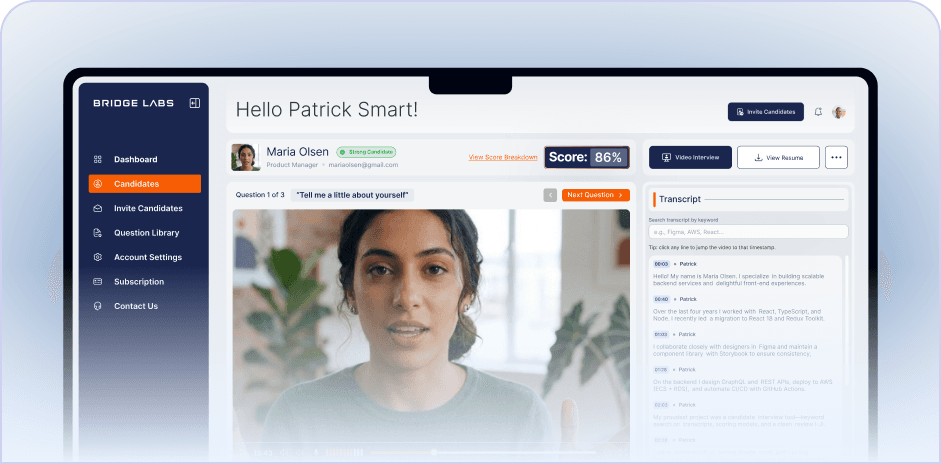
This step is especially critical if you are using AI scoring to evaluate responses. The scoring is only as useful as the rubric behind it. A well-defined answer framework turns AI evaluation from a pattern-matching exercise into a calibrated assessment, one that reflects your actual hiring standards rather than keyword density.
4. Make the Question Specific to the Role Context
Generic questions produce generic answers. If you are hiring a customer success manager for a B2B SaaS product, ask about managing renewals, handling escalations, or navigating situations where a customer's expectations do not align with what the product can do.
Do not ask about "a time you provided excellent customer service."
The more specific the question is to the role's context, the harder it is to answer with a rehearsed, nonspecific response. Specificity is your filter. It separates candidates who have done this work from those who have simply read about it.
5. Match the Time Limit to the Complexity of the Question
One of the most common design errors in one-way interviews is setting time limits that do not match the depth of thinking the question requires.
A behavioral question that asks a candidate to describe context, action, and outcome cannot be answered well in 60 seconds. A straightforward situational question does not need three minutes.
As a general guide:
- Simple situational questions: 60 to 90 seconds
- Behavioral questions requiring context and reflection: 2 to 3 minutes
- Role-specific scenario questions: 2 to 3 minutes
If candidates consistently run out of time before finishing, the question is too complex for the format.
If they consistently finish within the first 30 seconds of a two-minute window, the question is too narrow. Both are signals to revise before the next hiring cycle.
6. Keep the Question Set to Five or Fewer
More questions do not produce better shortlists. They produce longer review times and candidates who deliver their weakest answers by question six because they have run out of energy.
Five well-designed questions covering the core competencies of the role will give you more useful signals than ten questions that range from essential to filler. Ruthlessly cut anything that is not directly tied to a decision you would actually need to make.
Research from 2025 found that video interview tools produce a 75% faster shortlisting process compared to traditional methods. That efficiency disappears quickly when the question set is bloated.
7. Answer Your Own Questions Before Publishing Them
This is the most underused quality check in a one-way interview design.
Before you send the question set, record yourself answering each question as if you were a strong candidate applying for the role. Notice where the prompt is ambiguous. Notice where you would naturally want to ask a clarifying question. Notice where the time limit feels either too long or too short.
This exercise surfaces the questions that seem clear from the hiring side but are genuinely confusing from the candidate's perspective. Fixing those before the interview goes live costs you an hour. Reviewing 200 inconsistent responses because the question was unclear costs you significantly more.
What Not to Do
Do not ask the same questions you would ask in a live interview
The one-way format removes the back-and-forth that makes certain question types work in a live setting. "What questions do you have for us?" lands flat when there is nobody to answer. "Walk me through your resume" is redundant when you have already reviewed it. Design your questions for the format, not around habit.
Do not treat the one-way interview as the final evaluation
One-way interviews are a first-round screening tool. They are effective for narrowing a large applicant pool to a qualified shortlist. They are not a replacement for structured two-way interviews, panel conversations, or in-person meetings for roles where interpersonal judgment matters. Treat them as the beginning of the assessment process, not the end. Every candidate who makes it through deserves a real conversation before a hiring decision is made.
Do not skip the scoring rubric
Asking a strong behavioral question and then evaluating responses based on how confident the candidate looked on camera defeats the purpose. Define what you are looking for before the first response comes in. Candidates who speak quickly and with certainty should not automatically rank above those who pause to think before they answer.
Do not use the same question set across every role
A question set designed for a sales development role and one designed for a data analyst role should look completely different. Generic templates save time up front but cost you quality downstream.
Start With the Questions
One-way interview questions are a high-stakes design problem. They are also one of the most neglected parts of most hiring processes, which is exactly why getting them right matters so much.
Start with your competencies. Write behavioral and situational questions that produce meaningfully different answers. Define what a strong response looks like before the first candidate records anything. Keep the set tight. And test every question from the candidate's perspective before you publish it.
When questions are well designed, one-way interviews become one of the most consistent and fair first-round screening tools available. Every candidate gets the same shot. Every evaluator works from the same rubric. And your shortlist reflects actual qualification rather than who happened to have a recruiter available that morning.
The format is not the problem. It rarely is.
FAQs
How many questions should a one-way interview have?
Five or fewer. Beyond that, completion rates drop and response quality declines as candidates tire from the final questions. Five well-designed questions targeting your core competencies will give you more signal than a longer set that drifts into filler territory. If you are struggling to pare down the list, it is usually a sign that internal alignment on what you are actually hiring for is lacking.
How long should candidates have to answer each question?
Match the time limit to the question's complexity. Simple situational questions work well with 60 to 90 seconds. Behavioral questions that require context, action, and outcome need 2-3 minutes. Role-specific scenario questions also fall within that 2- to 3-minute range. If candidates are consistently hitting the limit before finishing, the question is too complex for the format. If they are done in 30 seconds, the question is too narrow.
How do I make one-way interviews feel less impersonal to candidates?
Start with a short video introduction from the hiring manager or recruiter explaining the role, the team, and what you are genuinely looking for. Then explain clearly who reviews the responses, how long the process takes, and what happens next. Two or three sentences of honest context go a long way. Candidates who understand why the format is being used and who is watching are significantly more likely to complete the process and walk away with a positive impression of the company.
Should a human still review one-way interview responses even when AI scoring is used?
Yes, always. AI scoring helps you prioritize and rank responses against a defined rubric, but it does not replace human judgment at consequential decision points. The recruiter reviewing the shortlist is still responsible for the hire decision. Think of AI scoring as a tool that surfaces the most relevant candidates faster, not one that makes the call for you. Any process that removes human review entirely before advancing a candidate assumes legal and ethical risks that the efficiency gains do not justify.
Latest From Our Blog
Discover fresh insights, trends, and tips on tech talent and offshore development. Stay informed with our latest updates