4 Ways On-Demand Interviews Improve Your Hiring Process
 Regine CyrilleTechnology14 Jul 2026
The average time-to-hire now sits at 41 to 44 days. That is down slightly from prior years, but 52% of companies still say their interview process takes too long.
The bottleneck usually is not the interview itself. It is the scheduling around it.
These are 4 important notions that are essential to consider:
1) Where the time actually goes
Coordinating a first-round interview across two or three people's calendars can eat up a week or more. Candidates wait, recruiters chase replies, and hiring managers get pulled into other priorities.
That delay has a real cost. 42% of candidates who drop out of a hiring process cite scheduling delays as the reason.
Your best candidates have other offers moving. Every day you spend finding a meeting slot is a day a competitor can close them first.
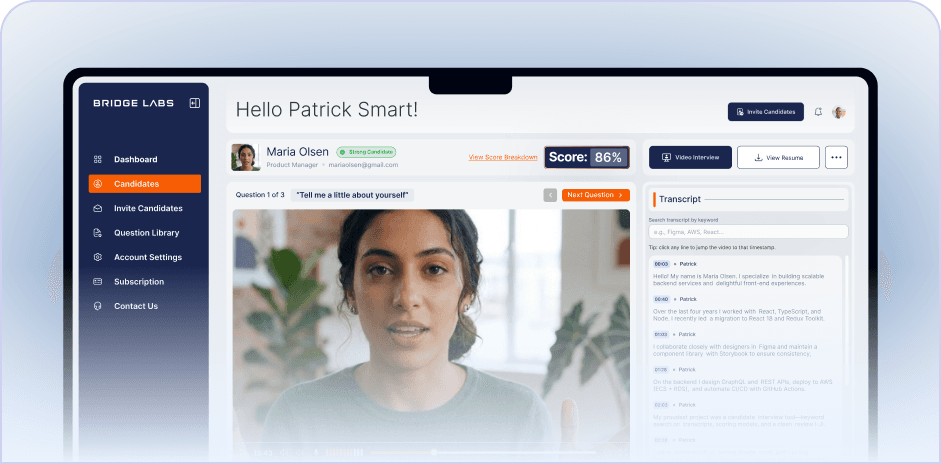
On-demand interviews remove that step. A candidate gets a set of questions, records their answers on their own time, and the hiring team reviews the responses whenever it works for them. No back-and-forth. No calendar tetris.
2)The impact on time-to-hire
Companies that have shifted early screening to on-demand video report a 50% reduction in time-to-hire and a 30% drop in recruitment costs. That is not a marginal gain. It changes how many roles a single recruiter can run at once.
The reason is straightforward: on-demand screening replaces the phone screen, not the real interview. It compresses the slowest, lowest-value part of the process, i.e., the initial filter, so your team's time goes into the conversations that actually decide who gets hired.
3) Does speed cost you quality?
This is a fair question, and it deserves an honest answer. Speed only helps if you are still hiring the right person.
Two things make on-demand screening work without cutting corners:
- Every candidate answers the same questions, in the same order, with the same amount of time. That consistency makes it easier to compare candidates fairly, something a string of differently-run phone screens rarely gives you.
- You can review answers when you are actually sharp, not squeezed between meetings. A recruiter reviewing five recorded screens back-to-back on Tuesday morning makes sharper calls than one doing five rushed phone calls spread across a chaotic week.
It is also worth being straight about the tradeoff: some candidates prefer a live conversation over a pre-recorded one, and a small share will hesitate before accepting an on-demand interview invite — even strong candidates. The fix is not abandoning the format. It is being clear about why you are using it and what happens next, so candidates know this step is a fast first filter, not the whole process.
4) Where it fits in your process
On-demand interviews work best as a replacement for the initial phone screen, not as a stand-in for every conversation.
Use them to filter at the top of the funnel. Move to live conversations with videos or in person, once you are down to a shortlist.
That combination gives you the speed gains without losing the human judgment that a final-round conversation still requires.
The bottom line
Time-to-hire problems are rarely about the interview itself. They are about everything that happens before it.
Cutting the scheduling delay out of your early screening is one of the highest-leverage changes a hiring team can make, and the data backs it up.
Latest From Our Blog
Discover fresh insights, trends, and tips on tech talent and offshore development. Stay informed with our latest updates