A screening process rarely fails in a way that announces itself, which is what makes this particular transition so difficult to catch. The tracker still opens every morning, and the columns still fill in, but what those columns contain has shifted from a record of your process to whatever individual recruiters remembered to type.
ATLAS's 2026 agency benchmark puts a number on how common that position has become, finding that 56.16% of agencies describe their recruitment technology as functional but fragmented
This article was written so that you can score your own desk against seven specific signs. If several of them describe how your agency operates today, you have a structural problem that rising volume will make worse, not better. If none of them apply, the final section sets out why staying on a spreadsheet remains the correct commercial decision.
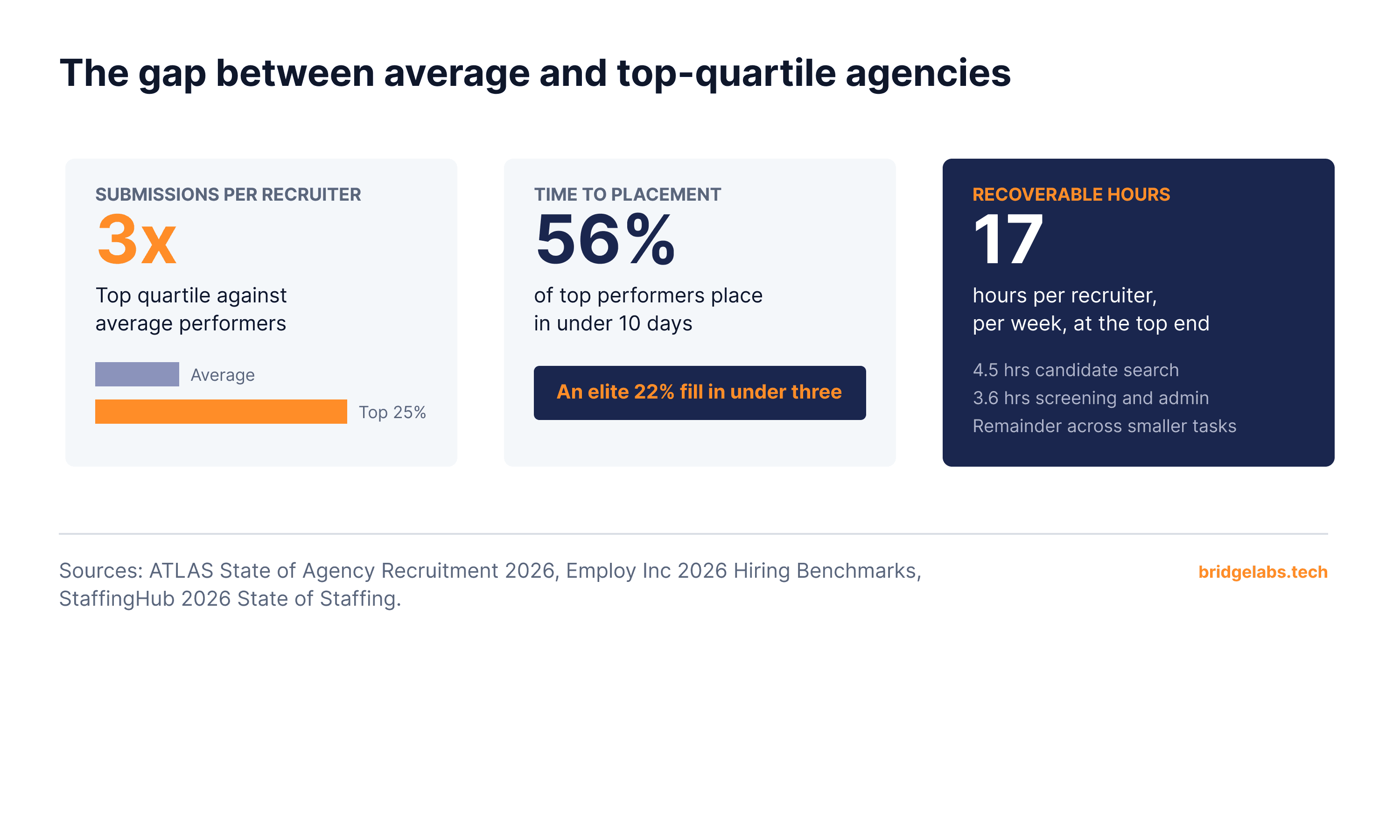
The benchmark data show a wide gap between agencies at the top of the distribution and those in the middle. The top quartile of agencies generate roughly three times as many submissions per recruiter as average performers, while 56% of top-performing agencies place in under 10 days, and an elite 22% fill in under 3 days.
A threefold difference in submissions per head is larger than any plausible difference in individual recruiter ability, which points toward the operating process rather than the people running it. The seven signs below are the specific process failures that tend to sit underneath a gap of that size.
This is the first and most consequential sign, because it invalidates everything downstream.
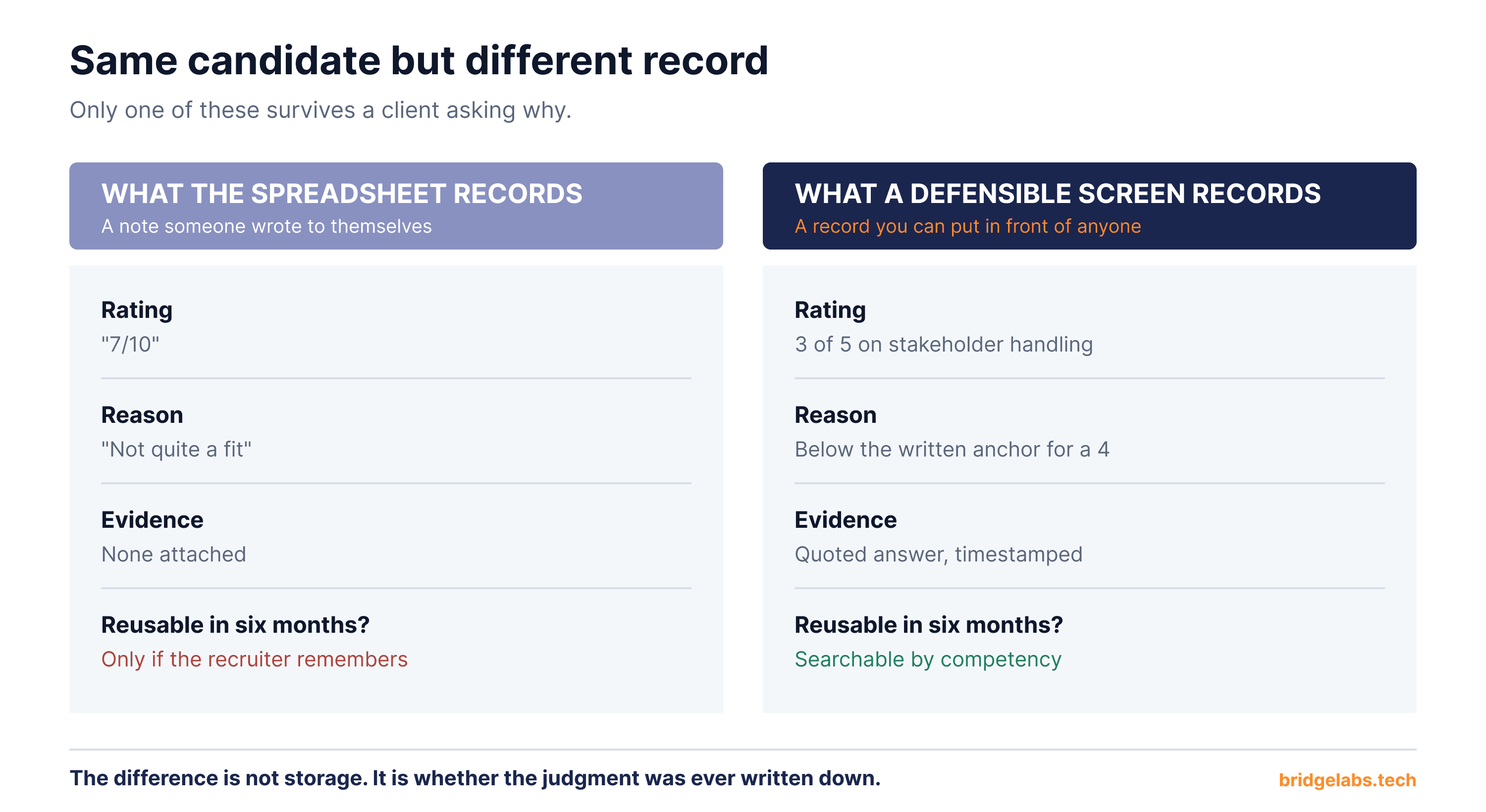
Two experienced recruiters interview the same candidate against the same brief, and one rates the candidate a strong yes, while the other lands on a maybe. Neither of them can point to the specific answer that produced their rating because the spreadsheet captured only a number and a short note, rather than the evidence behind it.
Test: Pull your last twenty placements and try to identify which recruiter screened each one from the notes alone. If the notes have a recognizable personal style, you have individual standards rather than an agency standard.
Discover fresh insights, trends, and tips on tech talent and offshore development. Stay informed with our latest updates

Benchmark data shows how much of a recruiter's week is currently consumed by work that produces no submission. Agency research points to AI-assisted workflows freeing up to 17 hours per recruiter per week, of which 4.5 hours are spent on candidate search and 3.6 hours on screening and administration.
Those hours matter because placement speed separates the top of the market from the middle, with 56% of top performers placing within 10 days. An agency spending eight of those weekly hours on coordination is competing for the same brief with a materially smaller working week than a competitor who has recovered them.
The sequence this produces on a single brief is worth tracing. A candidate is identified on day one; the screen happens on day three due to calendar availability; the write-up is finished on day four; and the submission lands on day five, behind a competitor who already had a screened candidate on their bench.
Test: For your last five lost briefs, record whether the client told you the candidates were wrong or whether someone else submitted first. If the losses cluster in the second category, the constraint sits in your process rather than in your sourcing.
At some point, a client asks about a specific candidate they saw on LinkedIn and wonders about them. Or a rejected candidate asks for a reason. Or the client's legal team asks how the shortlist was constructed.
A spreadsheet cell reading "not a fit" does not adequately answer any of those three questions. It is a note someone wrote to themselves in passing, and it will not survive being read aloud to the person asking.
Test: Pick a candidate rejected three months ago and reconstruct the reasoning using only what was written down. If you find yourself needing to ask the recruiter who screened them, what you have is not a record

Clients return with the same role six months later, and sometimes within the same quarter. If your screening history lives in a spreadsheet, the second search effectively starts from zero. The candidates you screened, scored, and rejected for reasons that no longer apply are functionally invisible, because nobody can query a scoring rationale that was never structured.
Test: When a repeat brief lands, how long before someone says, "Didn't we see someone good for this last time?" and how long before anyone can find them?
Onboarding is where the absence of a standard becomes expensive, because it converts into permanent variation.
A new recruiter shadows a senior colleague, absorbs that person's judgment, and then reproduces it on their own desk. Shadowing a different senior recruiter would have produced a noticeably different bar for the same role. Run that pattern for three years, and the agency ends up carrying as many standards as it has tenured staff.
Test: Hand a new recruiter a brief and your written screening criteria, with no shadowing at all. If they cannot produce a defensible shortlist from those two things, the standard was never written down in the first place.
Every agency accumulates candidates who screened well but were not a good fit for that particular brief. That screening work carries great commercial value, and most agencies lose access to nearly all of it within a quarter.
Reuse depends entirely on whether the original assessment was structured at the time it was recorded. A rating against defined competencies can be searched and filtered months later, whereas a paragraph of free prose cannot, which leaves redeployment dependent on whether a recruiter happens to remember the person.
Test: Produce a list of all candidates screened in the last quarter who scored well on a specific competency. If that is a manual exercise, you have a bench that you cannot access.
When monthly client reporting takes somebody half a day of copying between tabs, the reporting itself is not the underlying problem. It is a symptom indicating that the underlying data was never structured in a way that could produce a report.
Test: Measure how long it took somebody to assemble your last client report from start to finish. Anything beyond an hour per client is a recurring cost that the spreadsheet is charging you every month.
| # | Sign | Applies? |
|---|---|---|
| 1 | Two recruiters' scores on the same candidate cannot be reconciled from the record | 🔲 |
| 2 | We have lost briefs on submission speed rather than candidate quality | 🔲 |
| 3 | A rejection reason from three months ago cannot be reconstructed from what is written | 🔲 |
| 4 | A repeat brief means starting the search again | 🔲 |
| 5 | New recruiters learn the bar by shadowing, not from a document | 🔲 |
| 6 | We cannot query our screened bench by competency | 🔲 |
| 7 | Monthly client reporting is assembled by hand | 🔲 |
0 to 2 points. Your spreadsheet is still doing the job it's asked to do. Fix the individual sign that applies and revisit this checklist in six months.
3 to 4 points. You have a structural problem that rising volume will worsen rather than resolve. Start with signs 1 and 3, because those two carry both client and legal exposure.
5 or more points. The spreadsheet has become the binding constraint on your growth. Every additional recruiter and every new client widens the gap from here.
A shortlist of vendors, a demo each, a feature grid, a reference call, and a negotiation on price per seat.
Read ChecklistThis section matters at least as much as the seven signs, because for a meaningful share of agencies, the correct answer is to stay where they are.
A spreadsheet remains the right tool under the following conditions:
The calculation changes when two of those four conditions no longer hold simultaneously. In most agencies, the pair that moves first is headcount and volume, because growth in one tends to arrive alongside growth in the other.