Bridge Labs Logo

BRIDGE LABS

Solution

Bridge HR

Follow

LinkedinInstagramFacebookX

Resources

Insights

Use Cases

SMBsBPOsStaffing AgenciesStartupsEnterprise

© 2026 Bridge Labs. All rights reserved. | Privacy Policy | Terms and Conditions

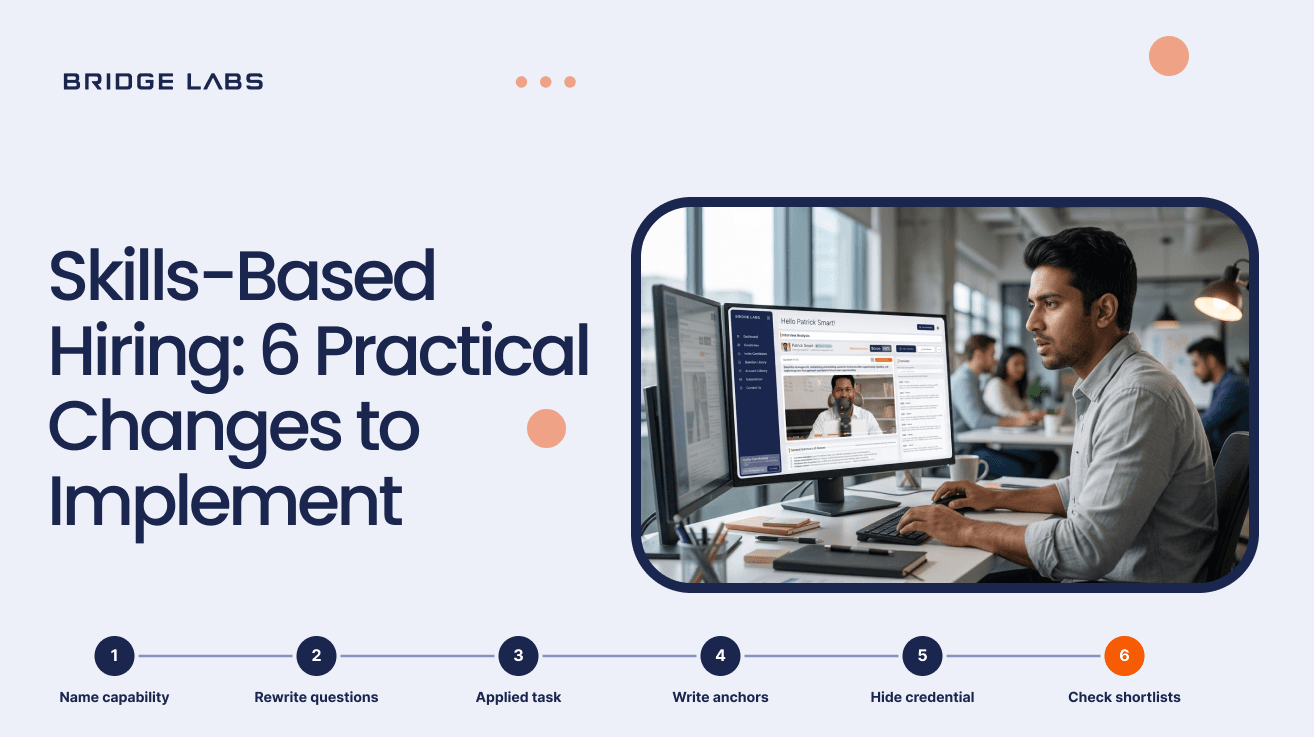
Skills-Based Hiring: 6 Changes That Separate Doing From Saying

Meli ImeldaMeli ImeldaHuman Resource20 Oct 2026
skills-based-hiring

Most organizations now say they hire for skills, and the evidence shows that very few of them changed how they select people.

This article covers what the adoption numbers show and the six changes at the screening stage that separate the organizations where skills-based hiring changed outcomes from those where it changed wording.

The Gap Between Saying and Doing

Adoption looks convincing in survey data. NACE's Job Outlook 2026 reports that 70% of employers use skills-based hiring, up from 65% the previous year, and that GPA screening has fallen from 73% of employers in 2019 to 42% today.

The hiring data tells a different story. Harvard Business School and the Burning Glass Institute found that around 3.6% of roles removed degree requirements, resulting in an average increase of 3.5% in non-degreed workers hired, and that fewer than 1 in 700 US hires in 2023 were affected.

The same research sorts employers into groups, and that split is the practical finding. Roughly 45% of firms changed their names only, with no meaningful difference in hiring behavior, while the leading group increased their share of workers hired without degrees by nearly 20%.

For the organizations that followed through, the outcome data is worth knowing. Non-degreed workers hired into those roles showed a two-year retention rate of 58%, compared with 48% for their graduate colleagues.

1. Replace the Credential With a Named Capability, Not With Nothing

Removing a degree requirement leaves a gap where a decision rule used to sit, and the research suggests most teams left that gap empty. Under time pressure, a reviewer will reach for whatever proxy remains, which is usually the employer brand on the CV or the degree that was never formally required but is still visible.

The replacement has to be specific enough to assess. "Strong analytical skills" is not a capability because two reviewers will interpret it differently, and neither can provide evidence for their rating afterward.

What to do: for each role, write three to five capabilities as observable actions. "Reconciles a ledger and explains a variance to a non-finance manager" can be assessed, whereas "attention to detail" cannot.

2. Write Questions That Make the Skill Visible

A skills-based process still fails if the questions invite a credential answer. Asking somebody to describe their background produces a narrative of where they worked, which is the thing you were trying to stop weighting.

Skill-revealing questions ask for the work itself rather than the history around it. The difference is small in wording and large in what comes back.

Latest From Our Blog

Discover fresh insights, trends, and tips on tech talent and offshore development. Stay informed with our latest updates
Subscribe to our Newsletter

Get the best insights on remote work, hiring, and engineering management in your inbox.

7 Signs Your Agency Has Outgrown Spreadsheet Screening

7 Signs Your Agency Has Outgrown Spreadsheet Screening

Human Resource09 Sept 2026
3 Considerations When Hiring Remote Software Developers

3 Considerations When Hiring Remote Software Developers

Human Resource29 Mar 2024
Video Interviews with AI Scoring: 6 Factors That Determine Accuracy

Video Interviews with AI Scoring: 6 Factors That Determine Accuracy

Human Resource05 Aug 2026
5 Rules for Scaling Pre-Recorded Interviews Without Losing Candidates

5 Rules for Scaling Pre-Recorded Interviews Without Losing Candidates

Human Resource09 Jul 2026
5 Tips for Vetting Remote Developers

5 Tips for Vetting Remote Developers

Human Resource04 Mar 2025
OpenAI Agent SDK: The Most In-Demand Developer Skill of 2025 | Complete Guide

OpenAI Agent SDK: The Most In-Demand Developer Skill of 2025 | Complete Guide

Technology01 Apr 2025

Screen It, Practice It, Score It.

Credential-inviting questionSkill-revealing version
"Walk me through your background""Walk me through how you would approach this specific task"
"What experience do you have with X?""Here is a situation involving X. What would you check first, and why?"
"Tell me about your training in Y""Describe a time Y went wrong and what you changed afterwards"
"Where did you learn this?""Show me how you would explain this to somebody who has not done it"

What to do: audit your question set and count how many answers could be satisfied by naming an employer or a qualification. Those are the ones to rewrite first.

3. Ask for Applied Skill Rather Than Claimed Skill

A list of skills on a CV is a claim, and a scored response to a task is evidence. The distinction matters most for candidates whose capability came from somewhere other than a formal program, which is the population skills-based hiring is supposed to reach.

A short scored video response works well here because it shows the skill in use rather than in summary. The candidate explains their reasoning, handles a constraint, and reaches a conclusion, and all three are visible to a reviewer in a way a bullet point never is.

What to do: pick the single capability that most predicts success in the role and build one task around it that every candidate completes under the same conditions.

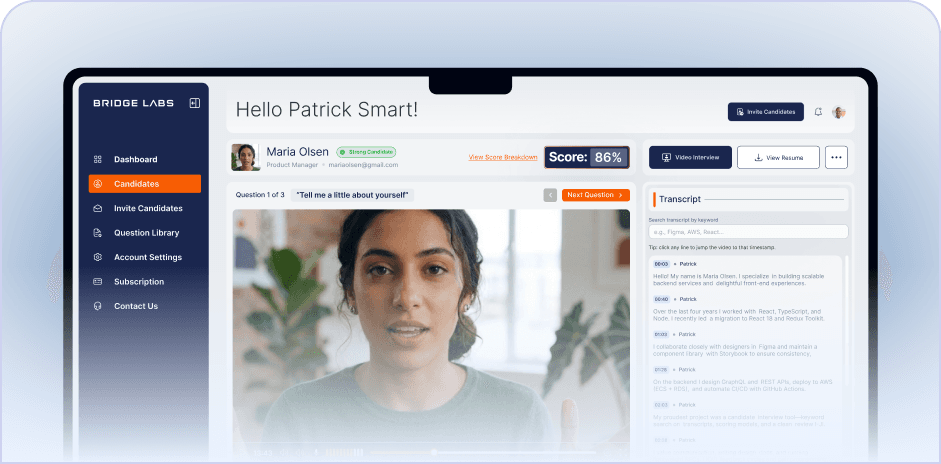
Try Skills-based hiring with BridgeHR

Removing a degree requirement only works if something replaces the judgment it was standing in for.

Bridge HR lets every candidate demonstrate their skill in a scored response against the same written anchors, so the shortlist rests on what people showed rather than what they studied.

Try it out here

4. Write Scoring Anchors Before Anyone Applies

This is where skills-based hiring most often collapses back into credentialism, and it happens quietly. Without written anchors describing what a weak, adequate, and strong answer looks like, reviewers fall back on their own sense of what good looks like, and that sense is shaped by the backgrounds they are used to seeing.

Anchors must be written in advance and describe evidence rather than impressions. A reviewer should be able to point at the part of the answer that produced the rating.

What to do: for each capability, write what a 1, a 3, and a 5 look like in concrete terms, and have two reviewers score five candidates independently before you use it on a live requisition.

5. Remove the Credential From the Reviewer's View at First Pass

If the degree still appears on screen during the first scored pass, it still affects the score, regardless of the policy. The cleanest test of whether your process is skills-based is whether the first assessment could be completed without knowing where somebody studied.

This is mechanically simple in most systems, and it is the change that keeps the others in place. It also makes the process defensible, because the rating is demonstrably based on the response rather than the background.

What to do: run first-pass scoring on the response alone, with education and employer fields hidden, and release them only after the score is recorded.

6. Check Whether Your Shortlists Changed at All

The HBS finding is that most organizations believed they had changed something, even as their hiring remained the same. The only way to know which group you are in is to measure the composition of your shortlists before and after.

Track the share of shortlisted candidates without the previously required credential, measured per role family rather than across the organization. An aggregate number hides precisely the pattern you are looking for, since one high-volume role can mask every other.

What to do: compare two quarters of shortlists per role family. If the composition is unchanged, the policy changed, and the screening did not.

The Skills-Based Screening Checklist
ChangeWhat it fixes
Three to five capabilities written as observable actionsThe empty gap left by the credential
Questions rewritten to ask for work, not backgroundAnswers that recite employers
Education and employer hidden at first-pass scoringThe proxy that operates below the policy
Scoring anchors written before applications openReviewers reverting to familiar backgrounds
One applied task per role, same conditions for allClaimed skill passing as demonstrated skill
Two reviewers calibrated on five candidatesAnchors that read clearly and score differently
Shortlist composition tracked per role familyDiscovering too late that nothing changed

Don'ts

  • Do not remove the degree requirement and stop there. The research is clear that this is the most common version of skills-based hiring and the one that changes nothing, because the judgment the credential was carrying has to go somewhere.
  • Do not replace a degree filter with a years-of-experience filter. Swapping one proxy for another reproduces the same exclusion with a different label, and tenure predicts less about capability than most teams assume.
  • Do not let skills be self-reported. A skills checklist on an application form is a claim collected at scale, and it rewards candidates who are confident with the terminology rather than those who can do the work.
  • Do not measure adoption by policy. Counting the job adverts you changed tells you about your wording. Counting the shortlists that changed tells you about your hiring.
  • Do not assess a capability nobody has defined. If two reviewers cannot agree on what constitutes a strong answer, the score is an opinion with a number attached.

FAQs

  1. Is skills-based hiring working anywhere?
    Yes, in the minority of organizations that changed their selection process rather than their job adverts. In that group, the share of workers hired without degrees rose by nearly a fifth, and those hires showed higher two-year retention than their graduate colleagues, suggesting the approach works when implemented rather than announced.
  2. Does this mean degrees are worthless as a signal?
    No, and treating the question that way is why many programs stall. A degree is a weak, cheap proxy for a bundle of capabilities, and the argument for skills-based hiring is that assessing those capabilities directly is more accurate, not that the proxy was random.
  3. How do we screen for skills at high volume without adding cost?
    Use one scored task per role family rather than a bespoke assessment per requisition, and run it as the first pass instead of as an extra stage. The cost problem usually comes from adding assessment on top of an existing CV screen rather than replacing it.
  4. What is the first sign that our process reverted?
    Shortlist composition that looks identical to the year before. That is the measurement the HBS research effectively ran across the market, and it is the one most organizations never run on themselves.
Hiring process