5 Tips for Vetting Remote Developers
Master the art of vetting remote software developers with these five tips from Bridge Labs. Ensure your tech projects are in expert hands with our insights and guidance.

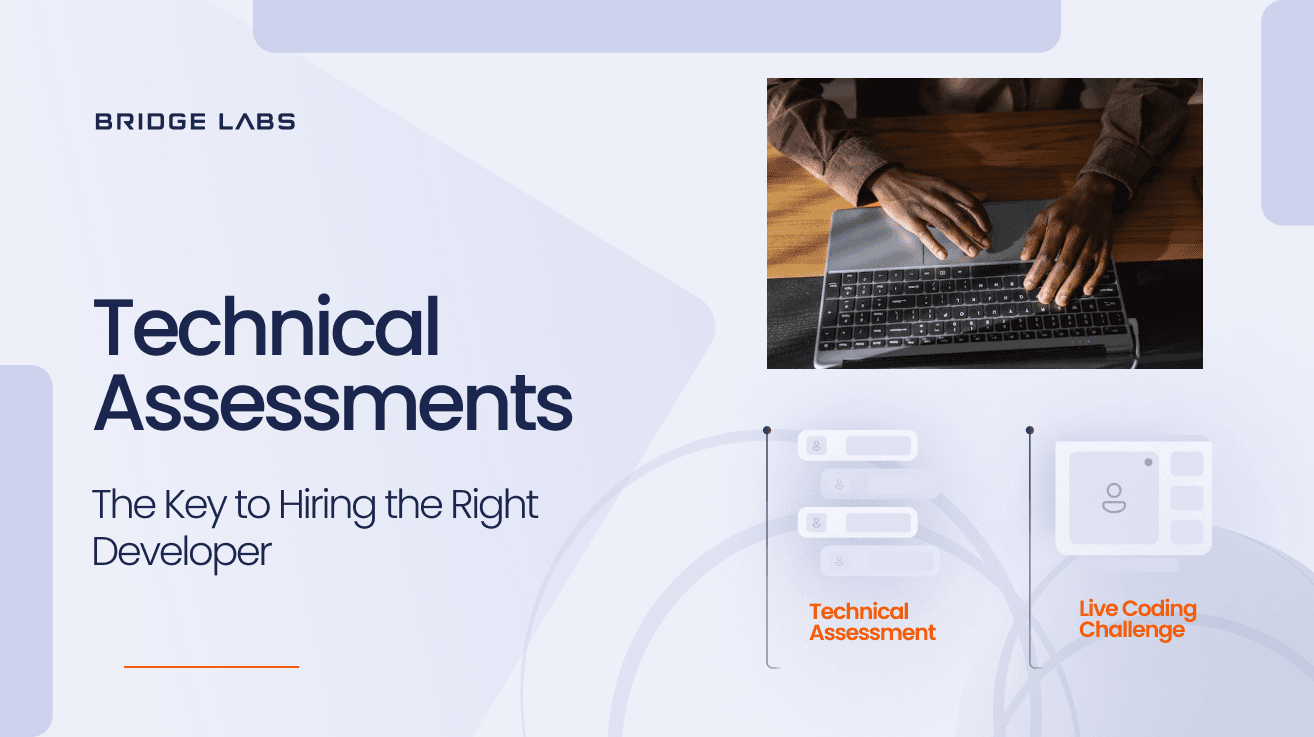
1. Why Technical Assessments Matter
- Coding Challenges and Online Tests
- Live Coding Interviews and Pair Programming
- System Design and Problem-Solving Exercises
- Soft Skills and Cultural Fit Evaluation
Did you know that companies using technical assessments report up to a 40% reduction in time-to-hire and a 75% increase in hiring success?
Studies have shown that structured evaluations streamline the hiring process and ensure that only the best candidates move forward.
This article explores how technical assessments can provide clear, objective insights into a candidate’s abilities and transform your recruitment strategy.
Technical assessments offer a unique window into a candidate’s abilities that resumes and interviews often miss.
They provide:
Online coding tests—using platforms like Devmatch, HackerRank, Codility, TestGorilla, or LeetCode—challenge candidates with real-world problems.
These tests reveal how efficiently a candidate writes clean, effective code under pressure.
For example, many companies have reported a 40% decrease in time-to-hire when incorporating such tests.
Live coding sessions and pair programming interviews allow you to see candidates in action.
Observing them solve problems in real time provides insights into their coding process, critical thinking, and time management skills.
For senior or specialized roles, system design interviews assess a candidate’s ability to architect scalable, efficient systems.
These exercises often involve whiteboarding sessions and discussions on trade-offs, performance, and future-proofing strategies.
Beyond technical prowess, evaluating soft skills such as communication, teamwork, time management, critical thinking, and adaptability is crucial.
Incorporating behavioral interviews and scenario-based questions ensures that candidates not only excel technically but also align with your company culture.
For maximum effectiveness, technical assessments should be easily included in the company's recruitment workflow and include job-relevant skills for the developers.
These are quick steps on how:
Are you ready to elevate your hiring strategy?
Let’s build the future of tech together.
Technical assessments are more than a mere recruitment hurdle—they are a strategic asset that bridges the gap between a candidate’s potential and an organization’s needs.
By incorporating diverse assessment methods and best practices into the hiring process, organizations can build a team that is not only technically proficient but also an excellent cultural fit.
Embrace these assessments to transform your company's recruitment process and secure the talent that will drive your organization forward.
Q1: Why are technical assessments crucial for hiring developers?
They provide objective insights into a candidate’s technical skills, reduce hiring bias, and simulate real-world challenges, resulting in better-informed hiring decisions.
Q2: What types of technical assessments should be used?
A combination of online coding challenges, live coding interviews, system design exercises, and soft skills evaluations offers a comprehensive assessment of both technical and interpersonal abilities.
Q3: How can we ensure fairness and consistency in our assessments?
By standardizing the testing process, providing clear instructions, and regularly updating the assessments to reflect current industry trends, companies can ensure a fair and consistent evaluation for all candidates.
Q4: How often should technical assessments be updated?
It is advisable to review and update assessments at least once or twice a year or whenever there are significant changes in technology or project requirements.
Source:HackerRank