Bridge Labs Logo

BRIDGE LABS

Solution

Bridge HR

Follow

LinkedinInstagramFacebookX

Resources

Insights

Use Cases

SMBsBPOsStaffing AgenciesStartupsEnterprise

© 2026 Bridge Labs. All rights reserved. | Privacy Policy | Terms and Conditions

5 Ways to Answer Better When AI Is Scoring Your Interview

Meli ImeldaMeli ImeldaWorkforce02 Oct 2026
Ways to Answer Better When AI Is Scoring Your Interview

Most guidance written about AI interviews offers either reassurance or alarm, and neither of those helps you in the four minutes before you hit record. What follows is tactical rather than reassuring.

There are five things to do differently when software is scoring your answer, one section covering what it cannot assess, so you stop spending effort there, and a note on what you are entitled to ask for. If you want the mechanics of how the pipeline works, we have written that up separately, and it is better read if you want to understand the system rather than perform inside it.

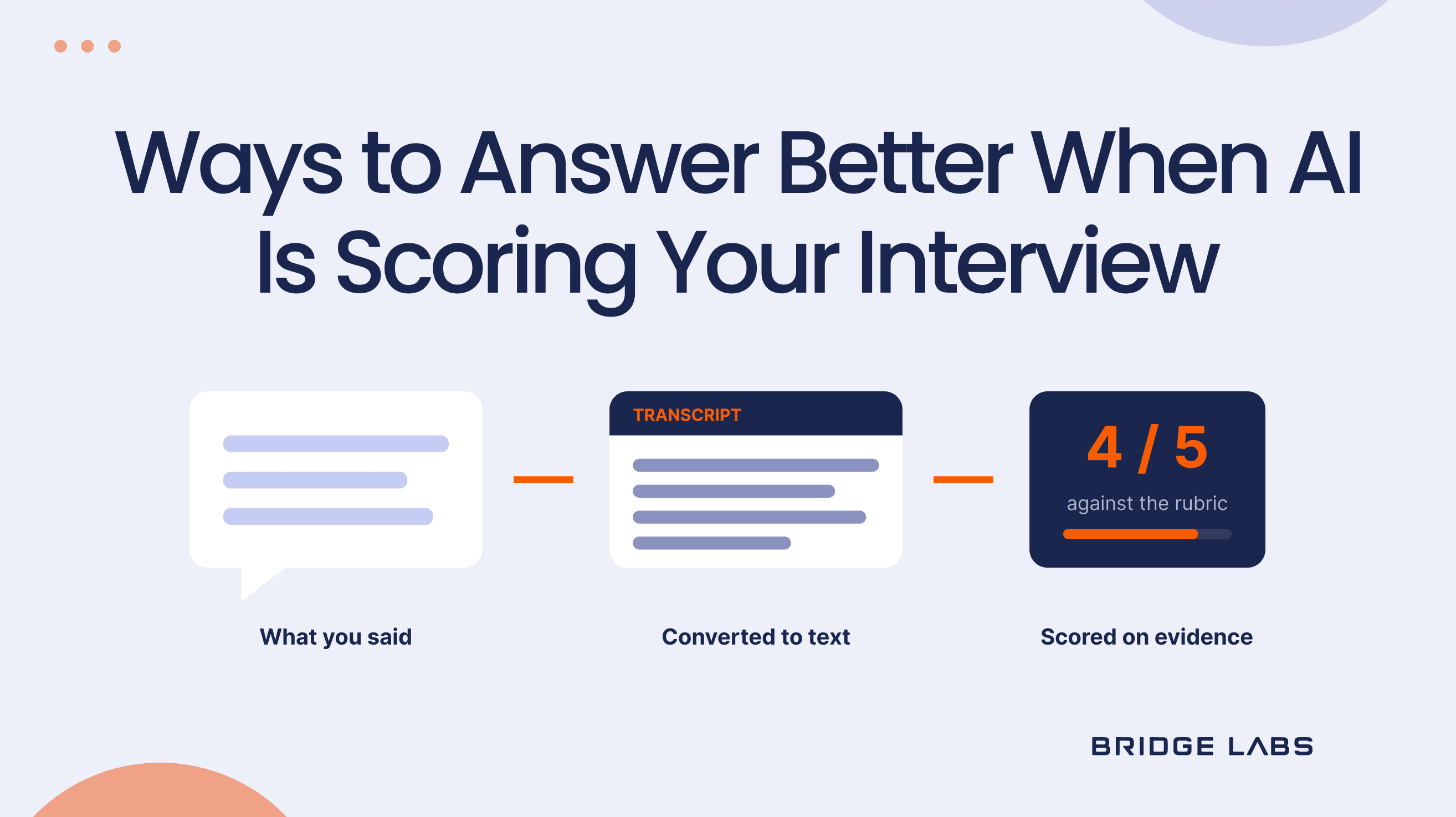
The short version of those mechanics drives everything below, so it is worth stating plainly. Most scoring runs on a transcript of what you said rather than on your face, which means your words are doing almost all of the work.

The Disclosure Situation

Candidates are frequently not told that software is involved at all. Only 18% of candidates say their employers have clear AI policies, which means the safe assumption is that a recorded answer may be scored rather than watched, and you should prepare on that basis.

Other candidates have already adapted to this reality. A 2026 survey of 1,000 active job seekers found 22% using AI during live interviews, and preparation for recorded rounds is more widespread still. Assuming that you are the only person taking this seriously is an expensive assumption to make.

Practise against a scored review

Rehearsing in front of a mirror tells you how the answer felt, which is the single thing nobody is assessing.

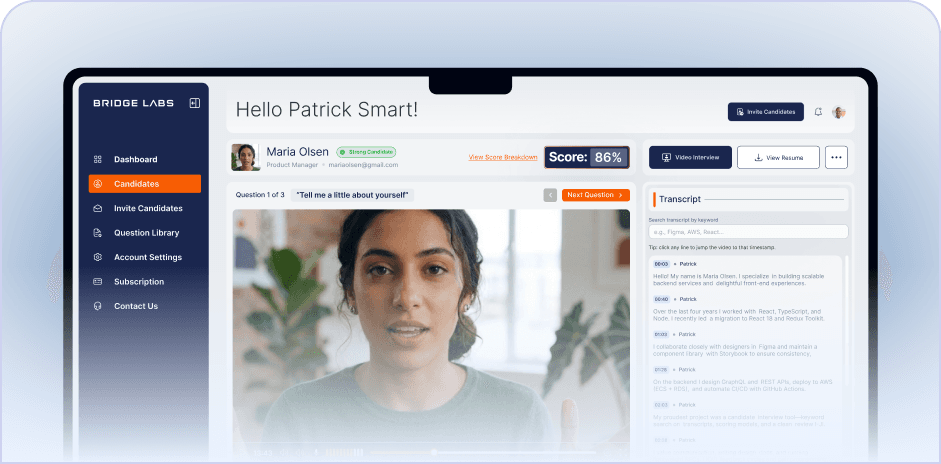
Record your answers in Bridge HR and see the same evidence a reviewer sees, including whether you addressed the question and where your structure held together

Practise Free

1. Answer the Question That Was Asked

This comes first because it outranks everything else on the list and because it is the most common failure by a considerable margin.

A strong answer to a question nobody asked will score poorly, and not because the software is unsophisticated. The rubric assesses whether your response addressed the prompt it was paired with; an off-target answer does not meet that test, however good it is.

The failure usually happens because candidates arrive with three prepared stories and deploy whichever one sits nearest to the question. Asked about handling conflicting priorities, they reach for the story about the difficult customer because the two feel adjacent in memory, and one is better rehearsed.

What to do: before you start speaking, say the question back to yourself in your own words and check it against your intended story. If the prepared story does not match, use a weaker one that does, because a mediocre on-target answer beats a strong off-target answer every time.

2. Lead With Specific Evidence

Claims cost you nothing to make, and they score accordingly, whereas evidence is the thing a rubric can locate and rate. The difference between the two is visible in the same answer told twice.

Before:

"I'm very organized, and I'm good at handling pressure. In my last role, there was a lot going on, and I was known for being someone people could rely on to get things done, even when deadlines were tight."

After:

"In my last role, I ran the month-end close for three entities on a four-day deadline. In the December cycle, two of our three reviewers were off sick, so I resequenced the checklist to front-load everything that didn't need review, and we closed a day early. That process is still what the team uses."

The same person with the same underlying competence appears in both versions. The second contains a number, a constraint, an action, and a result, while the first contains adjectives that would apply equally to almost every other applicant.

What to do: for every claim you intend to make, attach one verifiable fact to it. That can be a number, a timeframe, a named constraint, or an outcome, and if you cannot attach any of them, the claim is not worth the seconds it costs.

3. Build the Answer So the Transcript Reads Clearly

Rambling costs you marks for an entirely mechanical reason. The rubric asks whether your answer demonstrated a given competency, and either a reviewer or a model has to locate that demonstration inside everything you said, so burying it means it may never be found.

Signposting solves this problem cheaply and reliably. The old formula of "the situation was, what I did was, the result was" is unfashionable, and it works because it tells whoever is assessing precisely where to look.

Latest From Our Blog

Discover fresh insights, trends, and tips on tech talent and offshore development. Stay informed with our latest updates
Subscribe to our Newsletter

Get the best insights on remote work, hiring, and engineering management in your inbox.

7 Signs Your Agency Has Outgrown Spreadsheet Screening

7 Signs Your Agency Has Outgrown Spreadsheet Screening

Human Resource09 Sept 2026
3 Considerations When Hiring Remote Software Developers

3 Considerations When Hiring Remote Software Developers

Human Resource29 Mar 2024
Video Interviews with AI Scoring: 6 Factors That Determine Accuracy

Video Interviews with AI Scoring: 6 Factors That Determine Accuracy

Human Resource05 Aug 2026
5 Rules for Scaling Pre-Recorded Interviews Without Losing Candidates

5 Rules for Scaling Pre-Recorded Interviews Without Losing Candidates

Human Resource09 Jul 2026
5 Tips for Vetting Remote Developers

5 Tips for Vetting Remote Developers

Human Resource04 Mar 2025
OpenAI Agent SDK: The Most In-Demand Developer Skill of 2025 | Complete Guide

OpenAI Agent SDK: The Most In-Demand Developer Skill of 2025 | Complete Guide

Technology01 Apr 2025

Screen It, Practice It, Score It.

Weak patternWhat it costs you
Starting with context and never arriving at the pointThe competency is never demonstrated at all
Three examples delivered at half depth eachNone of them carries enough evidence to score
Answering, then adding, then answering againThe strongest version is buried in the middle
Ending on a tangentThe last thing heard is the least relevant thing

The second half of this applies specifically because scoring reads text. Warmth, timing, and physical presence carry a live conversation, and none of them survive transcription, whereas precision survives it completely intact.

Speak in complete sentences. Trailing off, interrupting yourself, and leaving clauses unfinished all read on a transcript as incoherence, even in cases where a listener would have followed you without any difficulty.

Name things explicitly rather than by pronoun. A sentence like "we used that system to fix it" loses everything that "we used the ticketing system to reroute overnight requests" keeps, because pronouns and vague nouns are where information disappears between speech and text.

What to do: keep to one point, one example, and one result, then stop when you reach the result, even if time remains. Afterward, read the transcript of a practice answer rather than watching the video, because a hard-to-follow transcript means the answer needs restructuring, however good it sounded.

4. Stop Optimizing for What It Cannot Assess

A considerable amount of candidate anxiety is spent on factors that carry no weight at all, and reclaiming that effort is worth doing deliberately.

Not assessed:

  • Facial expression and micro-expressions, since the major vendors moved away from visual analysis several years ago
  • Whether you smiled during the answer, and how frequently you did it
  • Your background, your lighting, and your room, beyond being clearly audible
  • Perceived confidence is treated as a personality trait rather than a behavior
  • How likable you come across to whoever is reviewing

Assessed:

  • Whether you addressed the question that was actually put to you
  • Whether you supplied specific and verifiable evidence for your claims
  • Whether the answer carried a structure that a reviewer could follow
  • Whether you covered the competency that the question was targeting
  • Audio clarity, because every transcription error costs you content

What to do: spend your preparation time on the second list rather than the first. Test your microphone properly, listen back to a sample, and then stop thinking about the room entirely.

5. Know What You Can Ask For

You hold more standing in this situation than most candidates do, and asking a direct question does not mark you out as difficult.

You can ask whether AI is involved in reviewing your interview and what it assesses. A growing number of jurisdictions require employers to tell you, and in the others, it remains an entirely reasonable question to put to a recruiter.

You can ask for an alternative process or an accommodation. This matters if you have a speech difference, a hearing difference, a strong accent, or any condition that makes a timed recording an unfair medium for you. Transcription performs less well on some voices than others, which is a legitimate basis for requesting an alternative rather than a reason to disclose more than you want to.

You can ask how long the recording is kept and who inside the organization will see it.

What to do: send the question in a short email to the recruiter before you record anything. Something like "could you tell me whether the recorded round is reviewed by a person, and whether an alternative format is available if I need one" is a single sentence, and it is entirely normal to send.

Pre-Record Checklist
#Check
1Microphone tested, with a sample recorded and played back
2You know how many retakes you get, because the employer sets this
3Three prepared examples, each with a number attached to it
4A one-sentence recovery line ready in case you fumble
5Timer target set for the question type you expect
6Self-view hidden or moved to sit directly under the lens
7Phone silenced, door closed, notifications switched off
8You have asked whether a person reviews it, if you wanted to

Run one scored round before the interview

Take a question you expect, record a single answer to it, and read the score against each item on the checklist above

Five minutes spent this way is worth more than an hour rehearsing the answer you already like

Practise here

What Not to Do

  • Do not stuff keywords into your spoken answers. Saying "stakeholder management" four times will not raise a competency score, and it reads as strange to any human who later watches the recording, because rubrics look for demonstrated evidence rather than term frequency.
  • Do not speak unnaturally slowly for the benefit of the transcription. Being clear is the goal, not being slow; artificially slow delivery reads as hesitant and eats into your time budget.
  • Do not read from a script positioned off-screen. It is audible in the rhythm of your delivery, and on a transcript, it produces prose that does not sound like speech, which is a signal in its own right.
  • Do not use a live AI assistant during a recorded round. Beyond the honesty problem it creates, answers generated on the spot are generic in precisely the way rubrics penalize, because they contain no specific evidence drawn from your own history.
  • Do not assume a failed recording is the end of the process. If something broke technically, tell the recruiter promptly because employers reopen rounds far more often than candidates expect.

FAQs

1. Can I tell whether AI is scoring my interview?

Not reliably from the candidate side of the process. A one-way recorded round with no interviewer present and a fast turnaround is a reasonable signal, though the only dependable method is to ask the recruiter directly; most will answer.

2. Does having an accent lower my score?

It can affect transcription accuracy, and transcription errors reduce the amount of content available for scoring. That is a limitation of the system, not a judgment about you, and it is a legitimate reason to request an alternative format. Speaking clearly helps the transcription, whereas changing your accent is neither necessary nor the actual fix.

3. Is it dishonest to prepare specifically for AI scoring?

No differently from preparing for a human interviewer who is working from a rubric. Every tactic above amounts to answering the question, supplying evidence, and being clear, which is what a good answer looks like in any format. Generating answers from a tool while the recording runs is an entirely different thing.

4. What if I get rejected by an automated screen?

You can ask for the reason and, in some jurisdictions, for human review of the decision. Put the request in writing and politely, because employers are increasingly required to keep records of these decisions, which means the answer usually exists somewhere.

Hiring process