Bridge Labs Logo

BRIDGE LABS

Solution

Bridge HR

Follow

LinkedinInstagramFacebookX

Resources

Insights

Use Cases

SMBsBPOsStaffing AgenciesStartupsEnterprise

© 2026 Bridge Labs. All rights reserved. | Privacy Policy | Terms and Conditions

What Video Interviews Score You On: 6 Categories Beyond Your Answer

Meli ImeldaMeli ImeldaWorkforce30 Sept 2026
what-video-interviews-score-you-on

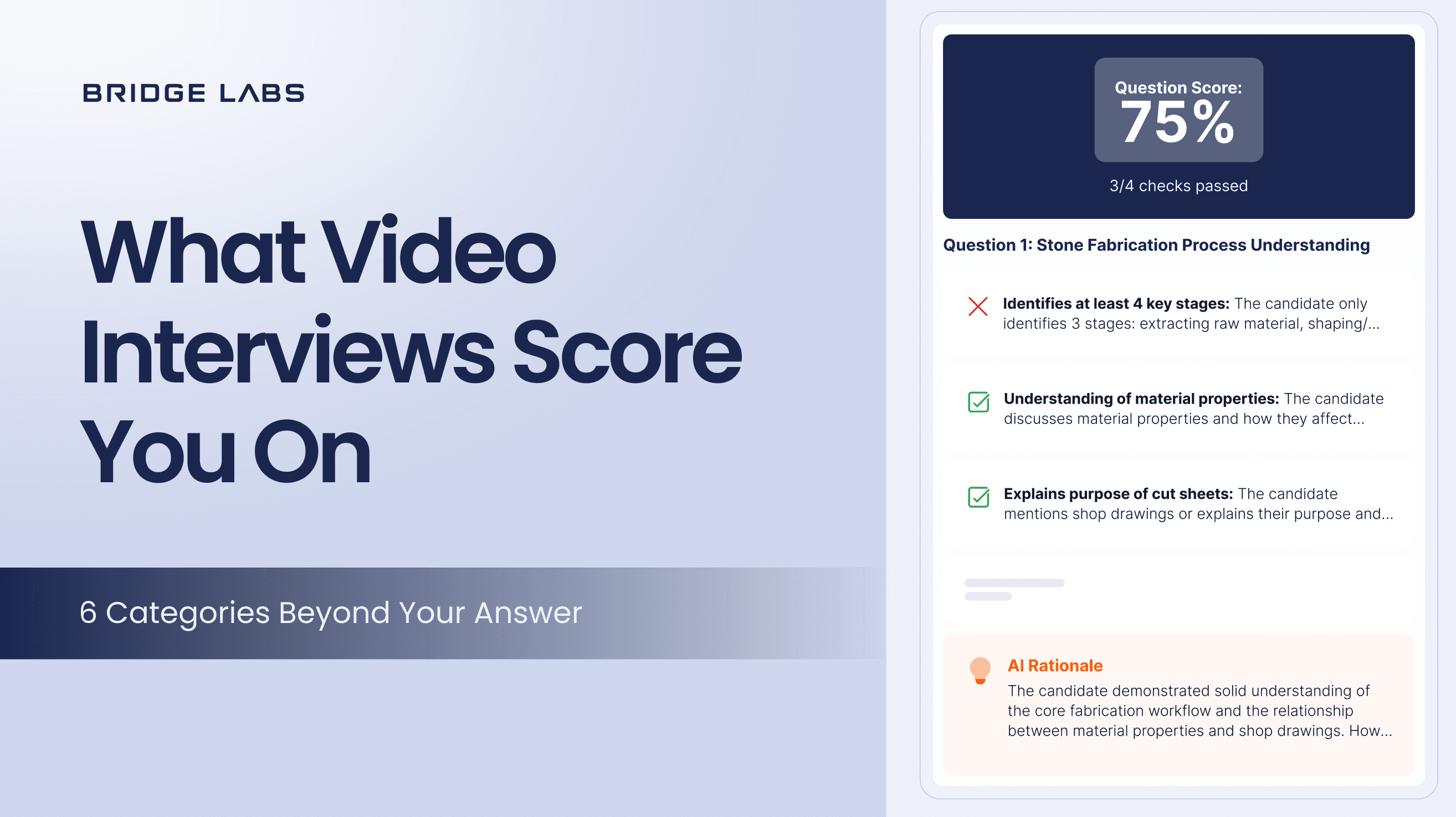
Most candidates prepare for a video interview by deciding what they are going to say, which is a reasonable instinct, but it covers less than half of the assessment. The reviewer on the other end is not starting from a blank page and forming a general impression of you, because in most structured processes they are working from a rubric with several named categories and a score for each one.

That distinction explains a pattern many candidates find difficult to account for. Someone can give a well-informed, substantially correct answer, know the subject thoroughly, and still land a middling score, since the content of the answer is only one of the things being rated.

This article sets out the six categories that typically appear on that rubric, explains why candidates systematically over-invest in one of them, and gives a specific fix for each.

What a Scoring Rubric Contains

Structured interview scoring is more standardized than most candidates assume. Current guidance on rubric design recommends that hiring teams build six to eight weighted competencies, which keeps the evaluation tight enough to score during the conversation while still covering what the role demands.

Those competencies carry different weights, and the weighting is where candidate assumptions tend to break down. In published structured evaluation frameworks, structure and clarity typically account for around 20% of the scoring weight, evidence orientation for a further 20%, and active listening for roughly 15%. Professional services firms follow a similar pattern, with case interviews scored across five to seven defined dimensions, including problem structuring, quantitative reasoning, business judgment, communication, and synthesis quality.

Read those weightings together, and a clear picture emerges. More than half of a typical score is attached to how the answer is built and delivered rather than to the underlying facts you brought to it.

Find out which category is costing you

Take the Quiz

1. Relevance: Did You Answer the Question That Was Asked?

This category is scored first and gates everything that follows, because an answer aimed at a different question cannot demonstrate the competency being tested. Candidates lose marks here more often than they realize, usually because they arrive with three polished stories and deploy whichever one sits closest to the prompt.

The mechanism is easy to miss from the inside. Asked about handling competing priorities, a candidate reaches for their well-rehearsed story about a difficult customer, because the two feel adjacent in memory even though they test different things.

Tip: before you start speaking, restate the question to yourself in your own words and check whether your intended story genuinely matches it. A weaker example that answers the question will outscore a stronger example that answers a neighboring one.

2. Structure: Can a Reviewer Follow Where You Are Going?

Structure is scored because it determines whether the reviewer can locate your evidence at all. An answer that wanders may contain everything the rubric is looking for while still scoring poorly, since nobody found the relevant part inside it.

The data on this is unambiguous from the employer side. Candidates who ramble or cannot produce specific examples are read as lacking depth or preparation in 53% of cases, which is a judgment about the shape of the answer rather than about the candidate's underlying ability.

Tip: commit to one point, one example, and one result for every answer you give. Signposting sounds unfashionable, but it works because phrases such as "the situation was" and "what I did was" tell the reviewer precisely where to look.

3. Evidence: Are Your Claims Attached to Anything Verifiable?

Evidence orientation carries roughly the same weight as structure in published frameworks, and it is the category where the gap between two candidates is usually widest. A claim about being organized costs you nothing to make and earns you very little, whereas a claim with a number attached becomes something a reviewer can score.

Compare these two versions of the same underlying competence. "I'm good at handling pressure, and people rely on me" contains no verifiable element whatsoever. "I ran month-end close for three entities on a four-day deadline, and when two reviewers were off sick in December, I resequenced the checklist, and we closed a day early" contains a scale, a constraint, an action, and an outcome.

Tip: attach one fact to every claim you intend to make, whether that is a number, a timeframe, a named constraint, or a result. If you cannot attach anything to a claim, it is not worth the seconds it costs you.

Latest From Our Blog

Discover fresh insights, trends, and tips on tech talent and offshore development. Stay informed with our latest updates
Subscribe to our Newsletter

Get the best insights on remote work, hiring, and engineering management in your inbox.

7 Signs Your Agency Has Outgrown Spreadsheet Screening

7 Signs Your Agency Has Outgrown Spreadsheet Screening

Human Resource09 Sept 2026
3 Considerations When Hiring Remote Software Developers

3 Considerations When Hiring Remote Software Developers

Human Resource29 Mar 2024
Video Interviews with AI Scoring: 6 Factors That Determine Accuracy

Video Interviews with AI Scoring: 6 Factors That Determine Accuracy

Human Resource05 Aug 2026
5 Rules for Scaling Pre-Recorded Interviews Without Losing Candidates

5 Rules for Scaling Pre-Recorded Interviews Without Losing Candidates

Human Resource09 Jul 2026
5 Tips for Vetting Remote Developers

5 Tips for Vetting Remote Developers

Human Resource04 Mar 2025
OpenAI Agent SDK: The Most In-Demand Developer Skill of 2025 | Complete Guide

OpenAI Agent SDK: The Most In-Demand Developer Skill of 2025 | Complete Guide

Technology01 Apr 2025

Screen It, Practice It, Score It.

ai-scoring-assessed-or-not

4. Clarity: How the Words Arrive

Clarity is where delivery stops being cosmetic and starts directly affecting the score. Speaking at pace or filling pauses with sound changes how a reviewer reads the same content, and it does so consistently.

Employer-side research puts a figure on it, finding that speaking above roughly 160 words per minute or overusing fillers such as "um" and "uh" is associated with nervousness or low confidence in 38% of assessments. The content did not change in those cases, but the rating did.

Tip: replace fillers with silence rather than trying to speak faster through them, because fillers are what your mouth produces while your brain catches up. A one-second pause feels alarming while you are doing it and reads as deliberate on playback.

5. Role Knowledge: Why This Organization Rather Than Any Other

Almost every rubric reserves a category for whether the candidate understands the organization and the role, and it is one of the easiest to prepare for and most commonly skipped. Insufficient knowledge of the hiring company is cited as a reason for rejection in 47% of unsuccessful interviews.

What scores here is specificity rather than enthusiasm. A sentence containing a concrete noun about the business will outperform three sentences about how excited you are by the mission, because only one of those is evidence that you did any work.

The fix: write one sentence naming something specific about the organization, such as the function being built, the market being entered, or a product decision you noticed. Place it at the end of your answer rather than at the beginning, where it reads as preparation rather than flattery.

6. Presence: How You Occupy the Frame

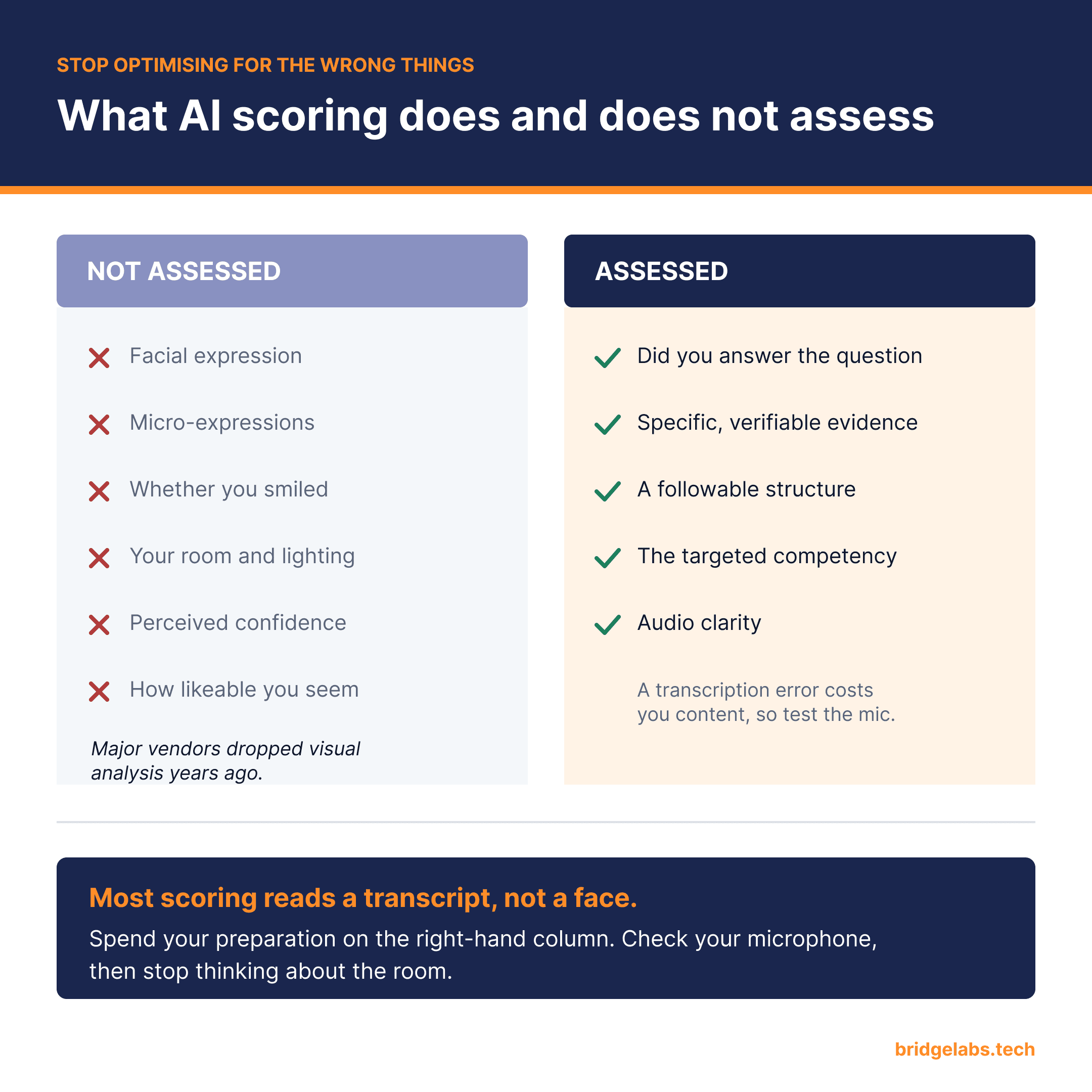
Presence is the category candidates worry about most and the one that has changed most in recent years. It is worth being precise about what is still assessed here, because a great deal of candidate anxiety is being spent in the wrong place.

What reviewers do register is whether you appear engaged in the conversation, whether your eye line suggests you are addressing them, and whether the audio is clean enough to follow without effort. What mainstream scoring systems no longer attempt is inference from facial expressions, since the major vendors moved away from visual analysis some years ago, as we covered in our guide to how AI video interview software works.

Tip: hide your self-view or move the window directly beneath the lens, because watching your own face is nearly involuntary and is the most common cause of a wandering eye line. Then test your microphone and play the sample back before you record anything that counts.

Score a recorded answer against all six categories

Free practice for job seekers. Record, get scored, fix the lowest category first

Practise Free

Why Candidates Over-Invest in Content

The pattern underneath all six categories is a predictable misallocation of preparation time. Candidates spend the overwhelming majority of their preparation deciding what to say, because content is the part that feels like the test and the part that can be researched from a desk.

Delivery resists that approach entirely, since it is a physical skill that improves only through repetition and feedback. Reading about pacing does not change your pacing in the same way that reading about a tennis serve does not improve one.

The result is a candidate who knows a great deal and scores moderately, which is a far more common outcome than a candidate who knows little and scores well. Employers have made this gap easier to detect, too, with 45% of mid-size and large companies now using AI-driven assessments or mock interview filters that evaluate communication alongside suitability.

How Scored Practice Closes the Gap

Four of the six categories above respond to repetition within days, which makes them the highest-return thing you can work on before an interview. Structure, clarity, evidence, and presence are all mechanical, and all four are visible to you the moment you watch a recording of yourself.

The difficulty is that self-assessment is unreliable on precisely these dimensions. Most people cannot count their own filler words while speaking, cannot judge their own pace against a benchmark, and cannot tell whether their structure was followable without someone attempting to follow it.

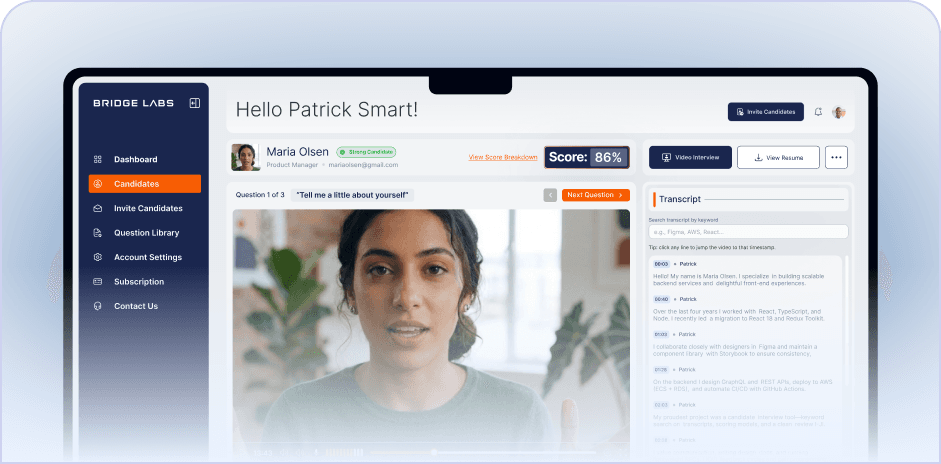
A scored practice round closes that gap by giving you the categories back as numbers rather than impressions. Record one answer, read the score against each category, fix the lowest one, and record again.

What Not to Do

  • Do not prepare only the content and assume delivery follows. Content preparation is necessary and addresses roughly two of the six categories, leaving the majority of your score untouched.
  • Do not try to fix fillers by speaking faster. Increasing the pace produces more fillers rather than fewer, and it pushes you over the threshold where reviewers read speed as nervousness.
  • Do not memorize answers word for word. A memorised answer is audible in its rhythm, and when you lose your place there is no structure underneath to carry you to the end.
  • Do not spend your preparation on your background and lighting. Those matter only to the point where you can be seen and heard clearly, well below the attention candidates routinely give them.
  • Do not practice without recording yourself. Rehearsing in your head skips the only feedback mechanism that reaches four of the six categories.
Hiring process