Bridge Labs Logo

BRIDGE LABS

Solution

Bridge HR

Follow

LinkedinInstagramFacebookX

Resources

Insights

Use Cases

SMBsBPOsStaffing AgenciesStartupsEnterprise

© 2026 Bridge Labs. All rights reserved. | Privacy Policy | Terms and Conditions

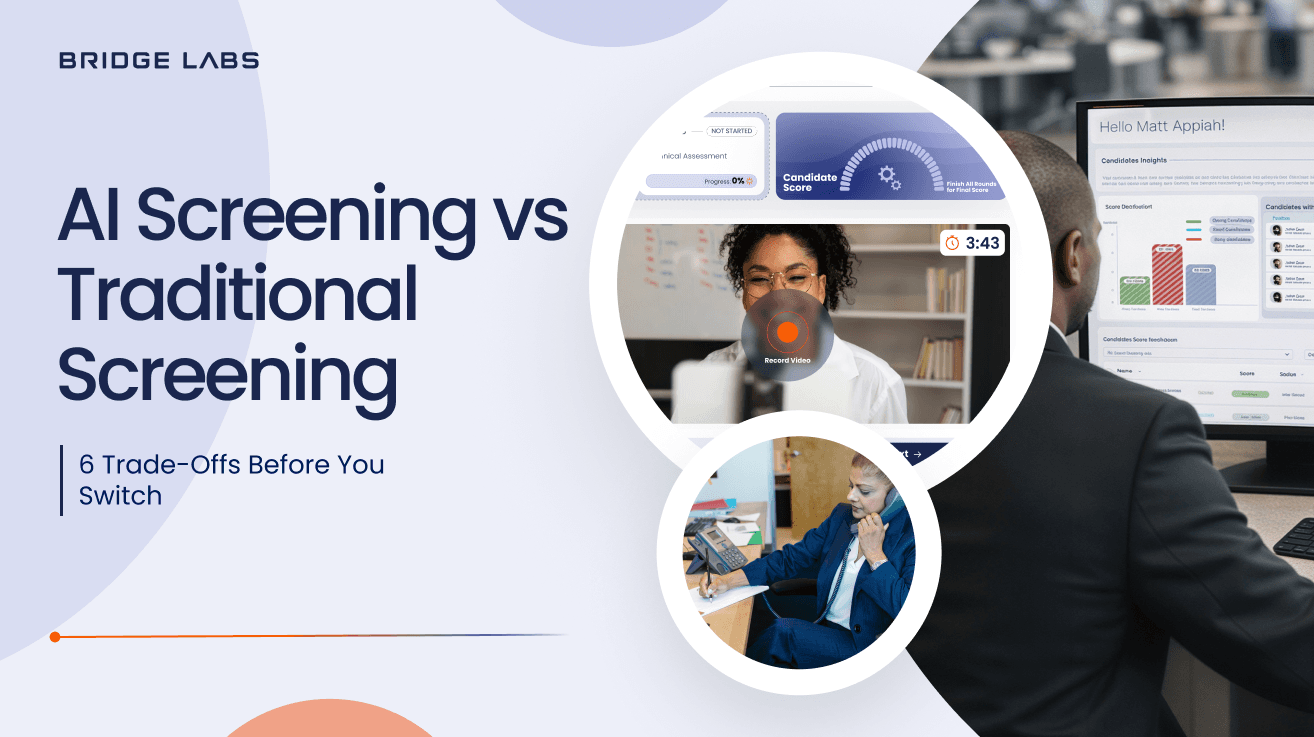
AI Screening vs Traditional Screening: 6 Trade-Offs Before You Switch

Meli ImeldaMeli ImeldaHuman Resource11 Aug 2026
AI Screening vs Traditional Screening

AI screening and traditional screening are usually compared as though one has to win outright, but the two behave differently enough across different parts of the hiring process that a single verdict tends to hide more than it settles. Break the comparison into its parts, and the picture separates cleanly. AI screening has a clear advantage in some areas; traditional screening performs better in others; and, in at least one case, the choice does not eliminate a risk so much as shift it to a less visible location.

So the more useful question is not which approach is better in general, but which set of trade-offs a particular team can absorb. That comes down to two variables above all: the seniority of the roles being filled and the volume of applications for them. A company filling 400 support seats a quarter and a company hiring three senior engineers a year can evaluate identical software and reach opposite conclusions, and both can be correct.

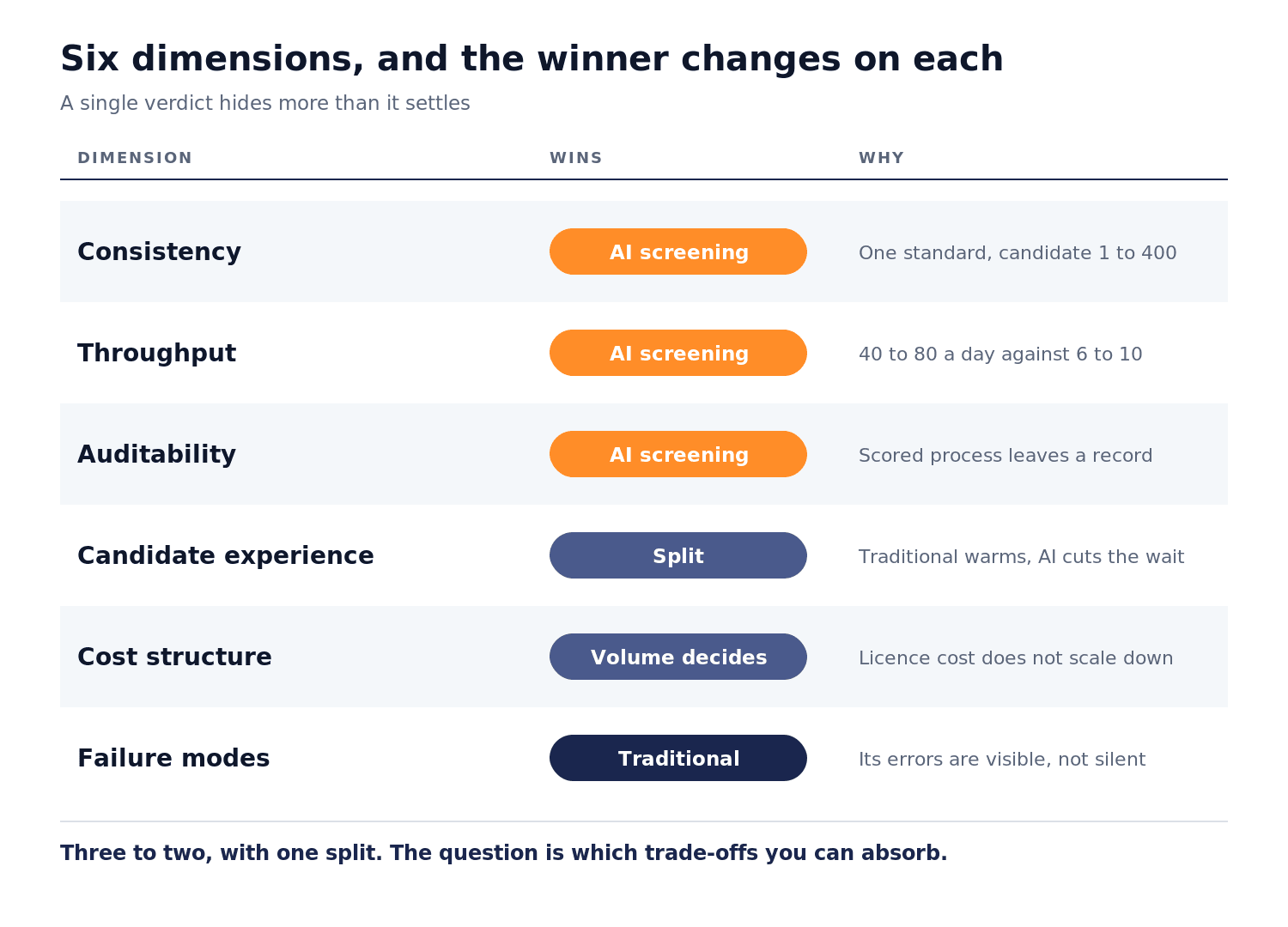
What follows is a comparison of the six dimensions in which the two approaches diverge most: consistency, throughput, auditability, candidate experience, cost structure, and failure modes. Traditional screening wins several of them.

The baseline both options are measured against

The case for AI screening is usually made on speed, and the case against it on fairness. Both framings are narrower than the decision requires, because each one treats the existing process as a fixed baseline rather than as a method with its own documented failure rate.

Traditional screening is not a neutral control group. It is a human under time pressure, and the pressure is increasing. Recruiter workloads climbed 93% year over year, and Gem's 2026 benchmarks put the offer rate at 0.5% of applicants, which means roughly 200 applications are processed for every hire.

That is the context in which both options are competing. So rather than asking whether AI screening is good, compare the two approaches on the six dimensions where they behave differently, and notice that the winner changes depending on which one you are looking at.

1. Consistency: AI Wins, But Consistency Is Not the Same as Correctness

A human reviewer applies a slightly different standard at 9 am than at 4 pm, and a different one again on the day a hiring manager is chasing them. A model applies the same standard to candidate 1 and candidate 400.

The cost of that human drift is measurable. Recruiters miss 20% to 30% of qualified candidates, with career changers, bootcamp graduates, and people with employment gaps frequently filtered out in the first few seconds of review.

But consistency cuts both ways, and this is the part vendors skip. A human who misjudges a candidate has made one mistake. A model with a poorly written rule makes the same mistake on every candidate it sees, silently, until someone audits it. 19% of organizations using hiring automation report their tools have screened out qualified candidates, and that is only the share who noticed.

Verdict: AI wins on consistency. Treat that as a multiplier rather than a virtue, because it amplifies whatever you configured, including the errors.

2. Throughput: AI Wins, and It Is Not Close

This is the dimension with the widest gap, and it is the reason most teams start looking in the first place.

Recruiters using AI screening review 40 to 80 candidates a day, compared with 6 to 10 with manual screening. Even at the conservative end, that is a fourfold difference in how many people get a genuine look rather than a glance.

The throughput gap matters most for fairness, which is a point that gets lost. When a recruiter can only reach 10 candidates a day, and 300 have applied, the other 290 are not being evaluated poorly. They are not being evaluated at all. Application order and resume formatting decide their outcome.

Verdict: AI wins clearly. The gain is coverage, not speed.

3. Auditability: AI Wins, and Most Teams Get This Backward

The instinct is that human screening is the safer legal option, because there is no algorithm to point to. The opposite is closer to the truth.

An unstructured phone screen produces almost no record. If a rejected candidate challenges the decision eighteen months later, you have a recruiter's memory and possibly four words in an ATS field. A structured, scored process produces a rubric, a score, and the evidence behind it.

That said, adopting AI does not move the liability anywhere useful. The Mobley v. Workday case reached class notice in February 2026, and the EEOC's position is that "the algorithm did it" is not a defense under Title VII. Buying a tool from a vendor does not transfer responsibility to that vendor. You own the outcome either way.

Verdict: AI wins on auditability, but only when the tool produces evidence you can retrieve. A score with no reasoning attached is worse than a recruiter's notes, because it looks authoritative and explains nothing.

Latest From Our Blog

Discover fresh insights, trends, and tips on tech talent and offshore development. Stay informed with our latest updates
Subscribe to our Newsletter

Get the best insights on remote work, hiring, and engineering management in your inbox.

Global AI/ML Developers Cost Comparison: Finding Value in a Competitive Market

Global AI/ML Developers Cost Comparison: Finding Value in a Competitive Market

Workforce14 Apr 2025
Africa's Growing Digital Infrastructure

Africa's Growing Digital Infrastructure

Technology04 Oct 2023
AI Screening in Recruitment: 5 Real Use Cases, Documented Risks, and What Independent Research Shows

AI Screening in Recruitment: 5 Real Use Cases, Documented Risks, and What Independent Research Shows

Human Resource18 May 2026
Bridge Labs & DevMatch: Streamlining Technical Assessments for African Software Developers

Bridge Labs & DevMatch: Streamlining Technical Assessments for African Software Developers

Human Resource25 Apr 2024
Best Communication Tools for Remote Developers 2025 | Team Efficiency Guide

Best Communication Tools for Remote Developers 2025 | Team Efficiency Guide

Human Resource02 Jun 2025
3 Considerations When Hiring Remote Software Developers

3 Considerations When Hiring Remote Software Developers

Human Resource29 Mar 2024

Screen It, Practice It, Score It.

4. Candidate Experience: Traditional Wins on Warmth, AI Wins on Waiting

Here, the answer splits by funnel stage.

Nobody prefers recording answers to a camera over talking to an interested person. A recruiter can sell the role, answer the question a candidate is too polite to ask twice, and read hesitation. That is a genuine advantage, and it grows more valuable the more senior the role.

The catch is that traditional screening rarely delivers that experience at volume, because the format collapses under coordination load. 67% of recruiters say scheduling a single interview takes between 30 minutes and two hours, and 35% name scheduling as the most time-consuming part of their job. Every one of those hours is time a candidate spends waiting.

There is also attrition built into the format. No-show rates for scheduled screens are in the 20%-25% range without intervention. A pre-recorded round does not have a slot to miss.

Verdict: Traditional wins the conversation, AI wins the wait. Most teams should use a video screening platform for the first pass and protect a live conversation for later rounds, which is the pattern we have argued before in our comparison of pre-recorded and live formats.

5. Cost Structure: AI Wins on Volume, Traditional Wins Below the Threshold

Cost per hire in the US is $5,475 for non-executive roles, according to SHRM's 2025 benchmarking data, and roughly 57% of that figure is recruiter time, internal labor, and sourcing spend. Screening sits squarely within the largest cost category, which is why it is the first place automation gets pointed to.

The per-screen numbers make the maths concrete. A 30-minute phone screen costs $32 to $58 once prep and ATS time are included, with the full block closer to 55 minutes end-to-end.

But license costs do not scale down. With 20 applicants for one role, a per-seat subscription is more expensive than the eight hours of screening it replaces. The break-even sits somewhere in the low hundreds of screens per year for most teams, and below that line, traditional screening is simply cheaper.

Verdict: depends entirely on volume. Run the calculation with your own numbers before assuming the software pays for itself.

6. Failure Modes: Traditional Wins, Because Its Failures Are Visible

Both approaches fail. They fail differently, and the difference matters more than the rate.

Human failure is distributed and self-limiting. One reviewer has a bad week, another catches what they missed, and the damage stays contained. AI failure is systematic. Parsing errors in unusual resume formats, keyword matching that misses equivalent skills described differently, and rigid experience filters applied inflexibly all produce rejections that look identical to legitimate ones from the outside.

The people this hits hardest are the ones least likely to complain, which is why the failure stays invisible. Nobody files a grievance over a rejection they assume was fair.

The mitigation is well established and worth adopting from day one. A hybrid split works better than either extreme: the top 15% to 20% advance automatically, the bottom 50% to 60% are declined, and the middle band goes to a person. That middle band is where the decisions are hard and where a model's confidence is least deserved.

Verdict: traditional wins. Not because it fails less, but because when it fails, you find out.

What not to do

  • Do not replace the whole first round at once. Run both in parallel on one requisition and compare the shortlists. If the overlap is high, the switch is safe. If it is low, you need to understand why before scaling, not after.
  • Do not assume the human process was working. Teams often benchmark a new tool against an idealized version of what they used to do. Pull your own numbers first: how many applicants got a genuine review last quarter, and how many were never opened.
  • Do not use volume as the only trigger. A role with 200 applicants and a role with 200 applicants where 180 are unqualified are different problems. The second one is a job advert problem, and screening software will process the noise faster without reducing it.
  • Do not skip the false-negative sample. Pull 30 rejected candidates a quarter and have a person review them cold. This is the only way to catch a systematic error before it becomes a pattern, and almost nobody does it.
  • Do not treat vendor accuracy claims as portable. A validation result from a high-volume customer service deployment tells you very little about how the same tool performs on your roles.

Making the call

Pick one requisition and score it on the six dimensions above using your own numbers rather than the general case. Volume, seniority, how much legal exposure the role carries, and how much of your recruiter's week currently disappears into scheduling.

If three or more of those points are in the same direction, you have your answer. If they are split, that split tells you to use both, which is what most functioning hiring processes do anyway.

The teams that get this right are rarely the ones that picked the correct one between the two. They are the ones who worked out which stage of their funnel each approach was suited to, then wrote that down so the choice stopped being made by whoever happened to be busiest that week.

FAQs

At what hiring volume does AI screening start to make sense?

The economics usually land somewhere in the low hundreds of screens per year, though the exact figure depends on your recruiter costs and license structure. Below that, the coordination savings do not cover the subscription. Above it, the gap widens quickly.

Is traditional screening more legally defensible?

Generally no. An unstructured conversation leaves almost no record to defend, while a scored process leaves a rubric and evidence. The exception is a tool that returns scores without any reasoning, combining the worst of both.

Can we use AI screening for senior roles?

For the first pass on a large senior pool, yes. For assessment, be cautious. Senior evaluation depends on judgment about trade-offs and context, which is where pattern matching is weakest and where a strong candidate is most likely to disqualify themselves by describing something in an unconventional way.

What is the single biggest mistake teams make when switching?

Removing the human review from the middle of the distribution. The top and bottom of a ranked list are easy, and both approaches agree on them. Every decision worth arguing about sits in the middle, and that is the band people delete first when they want to save time.

ai-screening
Hiring process