A global hiring standard exists to make outcomes comparable across markets, so that a shortlist assembled in one region carries the same meaning as one assembled in another. Most enterprise programs pursue that through a uniform process template, on the working assumption that identical steps will produce identical judgment.
How deviations get handled is where the approach tends to break down. When a regional team adjusts something to fit local hiring conditions, the adjustment is usually recorded as a compliance exception rather than examined as evidence that the standard has a gap. The result is that local knowledge continues to be applied but is no longer documented.
The failure mode is not standardization. It is standardizing the wrong layer.
Centralization is now the default. 71% of organizations report using a centralized operating model for talent acquisition, largely because it delivers the three things enterprise leadership asks for: consistency, visibility, and risk management.
The results do not match the intent. Only 7% of HR executives say their organization does an excellent job of managing consistent talent processes and systems globally, suggesting that most centralized models produce paperwork consistency rather than decision consistency.
Those two things get confused constantly. Not all regions filling in the same form are the same, nor are all regions applying the same bar. A template can be followed precisely and still produce wildly different outcomes because interpretation occurs in the gaps the template does not cover.
So the question is not how much to centralize. It is which layer to centralize, and what to hand back.
The thing worth making identical across every market is the definition of a good answer. The thing worth leaving flexible is nearly everything around it.
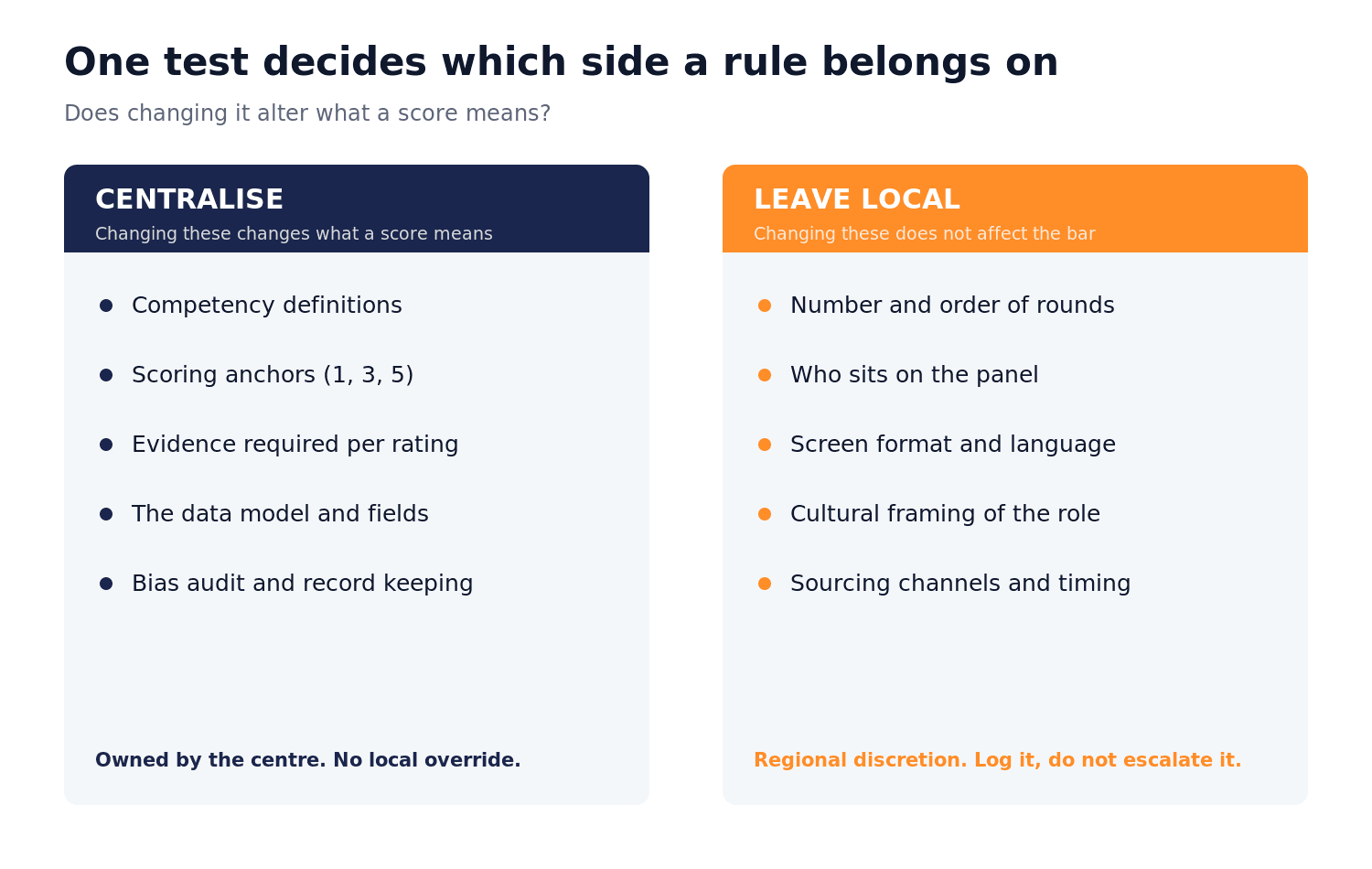
Centralise: the competencies, the scoring anchors, the evidence required to justify a rating, and the data you capture. These determine whether a score from Manila means the same as a score from Manchester, which is the entire point of a global standard.
Leave local: how many rounds, who sits on the panel, whether the first conversation is a call or a recording, how the role is culturally framed, and the sequencing relative to local notice periods and holidays.
Most enterprise programs do this backward. They mandate a five-stage process and leave "communication skills, rate 1 to 5" undefined, which means the ritual is identical everywhere, but the judgment varies.
Takeaway: If a regional lead asks to change something, the test is whether it affects what a score means. If it does not, approve it.
Local flexibility fails when it is informal, because informal flexibility is invisible to governance and gets withdrawn the first time something goes wrong.
The alternative is to write down what regional leads can change without having to ask. A discretion budget might cover interview sequencing, panel composition, the language a screen is conducted in, local sourcing channels, and a defined band of salary adjustment. Anything on the list can be changed unilaterally and logged. Anything not on the list goes to the centre.
This does more than speed things up. It converts a series of workarounds into a documented process, which is a considerable improvement from an audit standpoint. Every enterprise already has the workarounds. The choice is whether they are written down.
Takeaway: publish the list, review it twice a year, and add whatever regions have been working around anyway.
At enterprise volume, the recruiting function becomes a queue, and a queue has no name. Candidates end up corresponding with an address, hiring managers escalate into a ticketing system, and nobody owns the outcome end-to-end.
The fix is unglamorous and costs nothing. Every requisition gets one named person whose name appears in candidate correspondence and whom the hiring manager can contact directly.
This matters more as automation increases, not less. The more of the process a candidate experiences through software, the more weight the single human contact carries.
Takeaway: audit your candidate emails. If a candidate cannot reply to a person, that is your first fix.
Discover fresh insights, trends, and tips on tech talent and offshore development. Stay informed with our latest updates

Delay is the most common way enterprise processes feel impersonal, and it is almost always a decision-rights problem rather than an effort problem.
Arup addressed this by implementing structured interview debriefs and a 24-hour service-level agreement, ensuring candidates received prompt updates after each stage. The debrief is the mechanism that makes the SLA achievable because it forces the decision to be made while the panel is still assembled, rather than through a week of asynchronous chasing.
An SLA without a debrief is a target nobody can hit. Interviewers scatter, opinions drift, and the decision waits for the slowest calendar in the panel.
Takeaway: Book the debrief when you book the interview. Treat a missed debrief as a missed interview.
Volume pressure pushes teams to remove the last human round, since it is the most expensive per candidate. It is also the one that closes.
A candidate weighing competing offers is evaluating the company through the people they met. Someone who reaches the offer stage without speaking to a person has no reason to choose you beyond the compensation number, the one dimension where you are most easily outbid.
This holds even when earlier stages are heavily automated. Using pre-recorded screening at the top of a large funnel and a live conversation before an offer is a well-supported split, and we have covered in more detail how to decide where that handoff sits.
Takeaway: make the pre-offer conversation non-negotiable in policy, not a matter of recruiter discretion under pressure.
Enterprise talent functions are heavily instrumented on throughput and almost blind to satisfaction, which is why processes can look healthy in a dashboard while degrading in practice.
Only 33% of organizations measure hiring manager satisfaction, and the candidate side is worse. Just 11% of organizations survey candidates about their experience, and only 21% of candidates report having ever been asked.
Both are cheap to fix. Two questions to the hiring manager at the offer stage, two questions to every candidate at rejection or offer, segmented by region. The regional segmentation is what makes it useful, because it shows you where the global standard is being applied in ways that are technically compliant yet practically hostile.
Takeaway: If you measure nothing else, measure satisfaction by region. It is the earliest warning that a template has stopped fitting a market.
At enterprise scale, the overwhelming majority of people who experience your hiring process are rejected. The rejection is therefore not an afterthought to the candidate experience. It is the candidate experience for almost everyone who has one.
Most enterprise rejection copy is written once, approved by legal, and never revisited. It goes out unchanged to a candidate rejected on a knockout question in minute one and a candidate rejected after four rounds and eight hours of preparation. Those are not the same event and should not read the same way.
The minimum viable fix is two templates rather than one: the late-stage version acknowledges the time invested, names the stage reached, and comes from the named human on the requisition. It does not require personalization at scale, which is where these initiatives usually die. It requires two versions instead of one.
Takeaway: read your own rejection email as though you had spent eight hours on the process. If it does not survive that reading, rewrite it.
Pick your two most operationally different regions and put their hiring processes side by side. Not the documented ones. The actual ones, reconstructed from the last twenty hires in each.
The gaps between them are your discretion budget, already in use and currently undocumented. Write them down, decide which ones you are happy to sanction, and escalate only the remainder.
Then add the two satisfaction questions and the second rejection template. Those three moves cost almost nothing, require no new software, and address the part of enterprise screening that scale tends to erode first: the sense, on the other side of the process, that a person was involved at all.
How much should an enterprise standardize across regions?
Standardize the evaluation layer, which includes competencies, scoring anchors, and required evidence. Leave process mechanics local. The test for any rule is whether changing it would alter what a score means. If not, it does not belong in the global standard.
Does automated screening make enterprise hiring less human?
Not necessarily. It depends on where the recovered hours go. Automation at the top of the funnel can fund a longer, better conversation later, or it can fund a higher requisition load per recruiter. The technology does not decide which, and most organizations never make the choice explicitly.
What is the first thing to fix in a large hiring process that feels impersonal?
Response time. Delay does more damage to how a process feels than any other single factor, and it is usually caused by unclear decision rights rather than by a lack of effort. Fix the debrief and the SLA before you rewrite any copy.
How do we keep hiring managers bought into a central standard?
Measure their satisfaction and show them the result. Most resistance to central standards comes from managers who feel the process happens to them. Being surveyed and seeing something change as a result converts faster than any training rollout.