Bridge Labs Logo

BRIDGE LABS

Solution

Bridge HR

Follow

LinkedinInstagramFacebookX

Resources

Insights

Use Cases

SMBsBPOsStaffing AgenciesStartupsEnterprise

© 2026 Bridge Labs. All rights reserved. | Privacy Policy | Terms and Conditions

How to Reduce Phone Screen No-Shows: 5 Fixes That Recover Hours

Meli ImeldaMeli ImeldaHuman Resource01 Oct 2026
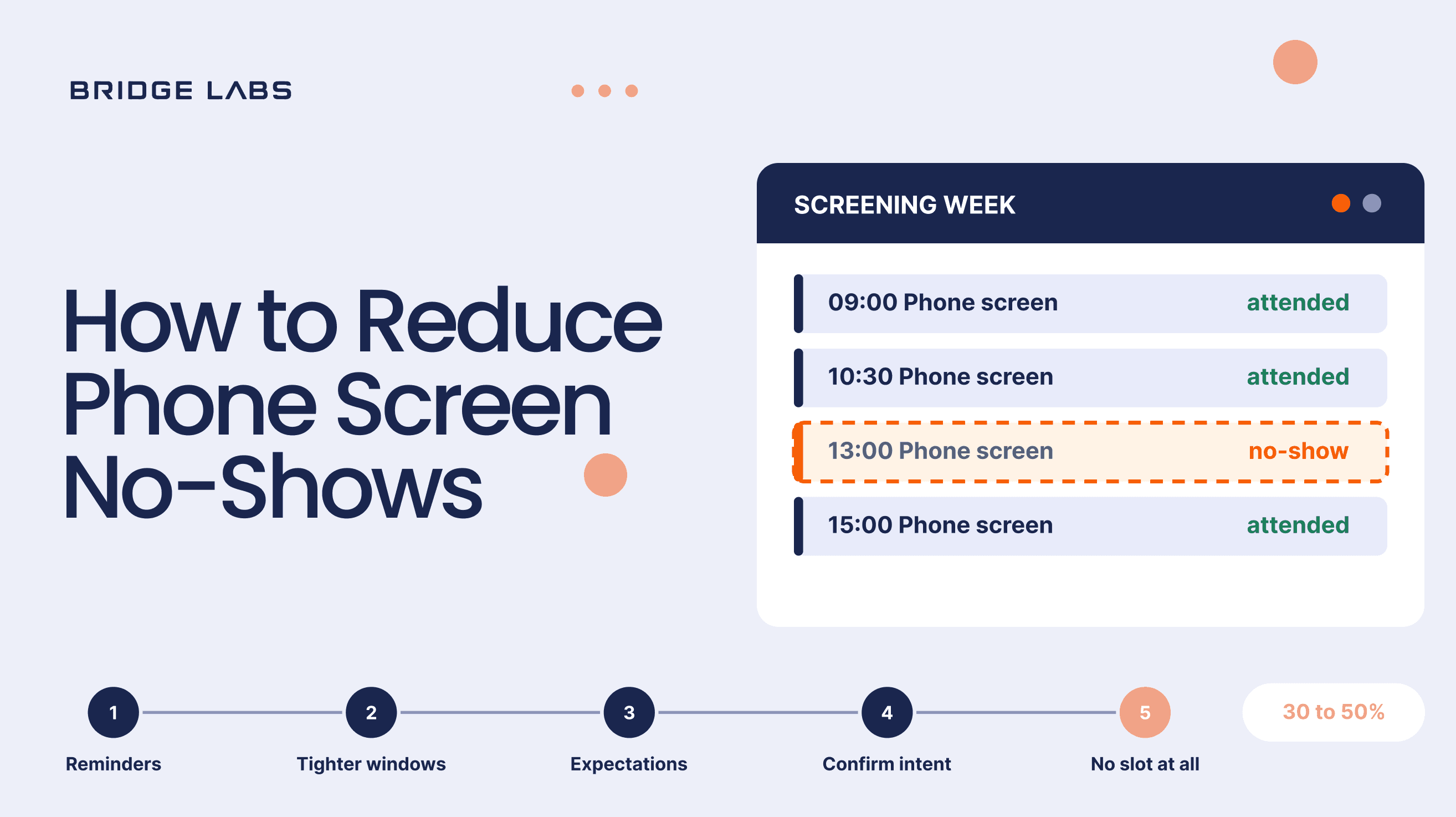
How to Reduce Phone Screen No-Shows

A phone screen that nobody attends still consumes the full cost of one that did. The slot was held, the brief was reread, the notes template was opened, and the fifteen minutes after the silence were spent working out whether to chase or to move on.

Most recruiting teams treat that as an irritation rather than a line item, which is why it rarely gets fixed. The teams that do fix it tend to start by working out what the empty slots are costing them each week, because a number changes the conversation in a way that frustration does not.

This article covers why candidates fail to appear, what each absence costs depending on when it happens, five fixes you can apply this week, and the point at which the appointment itself becomes the thing worth removing.

How Widespread the Problem Is

Interview absence is now close to universal, rather than an occasional annoyance. Recent industry data show that 60% of hiring teams have had candidates fail to show for a scheduled interview, while 39% have had candidates vanish mid-process after the team has already invested meaningful time.

The behavior runs in both directions, which matters for how you respond to it. 41% of organizations report candidates ghosting them during interviews, while 61% of job seekers report being ghosted after an interview, a figure up nine points on the prior period.

Treating candidate absence purely as a candidate failing is therefore a weak diagnosis. A meaningful share of it is a response to how the process has treated people, and the fixes that work address both sides.

Why Candidates Fail to Appear

Three causes account for most of it, and each calls for a different response.

  1. Scheduling friction. The longer the gap between a candidate agreeing to a time and the time arriving, the more opportunity there is for the commitment to decay. Rescheduling by email thread compounds this, because a candidate who needs to move a slot often finds it easier to disappear than to negotiate.
  2. Competing offers and parallel processes. Candidates run several processes at once, and the one that moves fastest tends to take precedence. A screen booked nine days out is competing against an employer who has already made a decision.
  3. A cold candidate who never warmed up. Someone who applied months ago or has heard nothing since applying has very little invested by the time the invite lands. 24% of candidates who ghost cite slow communication or long delays as the primary reason, which places the cause inside the process rather than in the candidate.

What a No-Show Costs, by Stage

The cost is not uniform, and understanding its shape tells you where to concentrate effort. Sunk interview time per candidate who disappears runs from roughly $250 at the early stages to as much as $4,500 once a full loop has been invested.

Dropout rates also vary by where you are in the process, with mid-loop dropout running at 5 to 12% per stage, post-onsite and pre-offer at 8 to 18%, and post-offer-accepted at 5 to 12%.

Latest From Our Blog

Discover fresh insights, trends, and tips on tech talent and offshore development. Stay informed with our latest updates
Subscribe to our Newsletter

Get the best insights on remote work, hiring, and engineering management in your inbox.

7 Signs Your Agency Has Outgrown Spreadsheet Screening

7 Signs Your Agency Has Outgrown Spreadsheet Screening

Human Resource09 Sept 2026
3 Considerations When Hiring Remote Software Developers

3 Considerations When Hiring Remote Software Developers

Human Resource29 Mar 2024
Video Interviews with AI Scoring: 6 Factors That Determine Accuracy

Video Interviews with AI Scoring: 6 Factors That Determine Accuracy

Human Resource05 Aug 2026
5 Rules for Scaling Pre-Recorded Interviews Without Losing Candidates

5 Rules for Scaling Pre-Recorded Interviews Without Losing Candidates

Human Resource09 Jul 2026
5 Tips for Vetting Remote Developers

5 Tips for Vetting Remote Developers

Human Resource04 Mar 2025
OpenAI Agent SDK: The Most In-Demand Developer Skill of 2025 | Complete Guide

OpenAI Agent SDK: The Most In-Demand Developer Skill of 2025 | Complete Guide

Technology01 Apr 2025

Screen It, Practice It, Score It.

StageTypical dropoutSunk cost per lossWhat you lose
Phone screenHighest volumeLower end of the rangeA held slot and the context switch
Mid-loop5 to 12% per stageRisingMultiple calendars already committed
Post-onsite, pre-offer8 to 18%HighA full panel's time plus a stalled requisition
Post-offer accepted5 to 12%Up to the top of the rangeThe requisition reopens from scratch

The knock-on effects land on people outside the recruiting team as well. Industry reports show that 47% of teams cite increased recruiter workload and 42% cite wasted hiring manager time as consequences of no-shows.

Takeaway: phone screens are where the volume is, even though the per-event cost is lowest, making them the right place to start.

1. Send Three Reminders in the Final 48 Hours, Each With a Way Out

This is the highest-return change available, and it requires no new tooling whatsoever. Moving from a single reminder to three reminders across the 48 hours before a scheduled interview cuts the no-show rate by 30 to 50%.

The spacing matters more than the volume of messages being sent. One at 48 hours re-establishes the commitment, one the evening before allows a candidate to reschedule rather than vanish, and one roughly an hour ahead handles the people who simply lost track of the day.

What goes inside those messages matters as much as their timing. Most no-shows are not decisions to waste your time, but rather the path of least resistance for someone whose circumstances have changed and who now faces an awkward email to move the slot. If a one-click reschedule link appears in every reminder, that awkwardness disappears, and you recover the slot with notice rather than losing it in silence.

The joining link belongs in all three messages for the same reason. Hunting through an inbox for dial-in details minutes before a call is itself a documented cause of absence and entirely preventable.

Do this: confirm at booking, remind the evening before, and remind an hour out. Put both the joining link and a self-serve reschedule link in each one, with wording that explicitly invites rescheduling rather than burying it.

2. Shorten the Gap Between Booking and Screening

Every additional day between the agreement and the appointment is an opportunity for a competing process to be resolved first. A screen that occurs within 48 hours of the candidate agreeing to it shows far less decay than one scheduled nine days out.

This is usually a capacity design problem rather than an individual scheduling problem. Teams that hold two or three standing screening blocks each week can consistently offer a slot within 48 hours, whereas teams that schedule around whatever gaps remain cannot.

Do this: block fixed screening windows in advance and offer only those, rather than opening your whole calendar and accepting whatever is furthest away.

3. Tell the Candidate What the Call Will Cover

An invite reading "30-minute call" gives a candidate nothing to prepare for and nothing to value. An invite that names who they will speak to, what will be covered, how long it will run, and what happens afterward turns an appointment into a step in a process.

This also filters usefully. A candidate who reads what the screen covers and decides against it is better off withdrawing in advance than failing to appear, since a withdrawal returns the slot to you.

Do this: write one invite template that includes the interviewer's name and role, three bullet points on what the conversation covers, the duration, and the next step.

4. Confirm Intent Rather Than Availability

Asking somebody whether a time works is a question about their calendar. Asking whether they still want to proceed, given what the role pays and where it is based, is a question about their intent, and the two produce different information.

A short confirmation message that restates the salary band, the location or remote policy, and the working pattern will surface mismatches before the call rather than during it. Candidates who were never going to proceed tend to answer that message honestly.

Do this: include the band and the working arrangement in the confirmation, and ask the candidate to confirm that both still work for them.

5. Remove the Appointment From the First Round Entirely

The four fixes above manage no-shows and will meaningfully reduce them. The fifth changes the shape of the problem, because a round with no scheduled slot has nothing to fail to attend.

A pre-recorded round that a candidate completes on their own schedule converts a coordination problem into a completion rate, and the two behave very differently. When a candidate does not complete a recorded round, no recruiter's hour is spent waiting, no slot is held, and no hiring manager is kept available.

It is worth being honest about what this does and does not solve. Candidate drop-off does not disappear, as average completion rates for async rounds are around 72%, with junior candidates completing at 78%, mid-level at 74%, and senior at 65%. People still decline to proceed, which is why a video screening platform shifts who bears the cost of that decision rather than eliminating it.

Do this: move first-round screening to a recorded, scored format and keep live conversations for later rounds, which is the split we set out in asynchronous versus live video interviews.

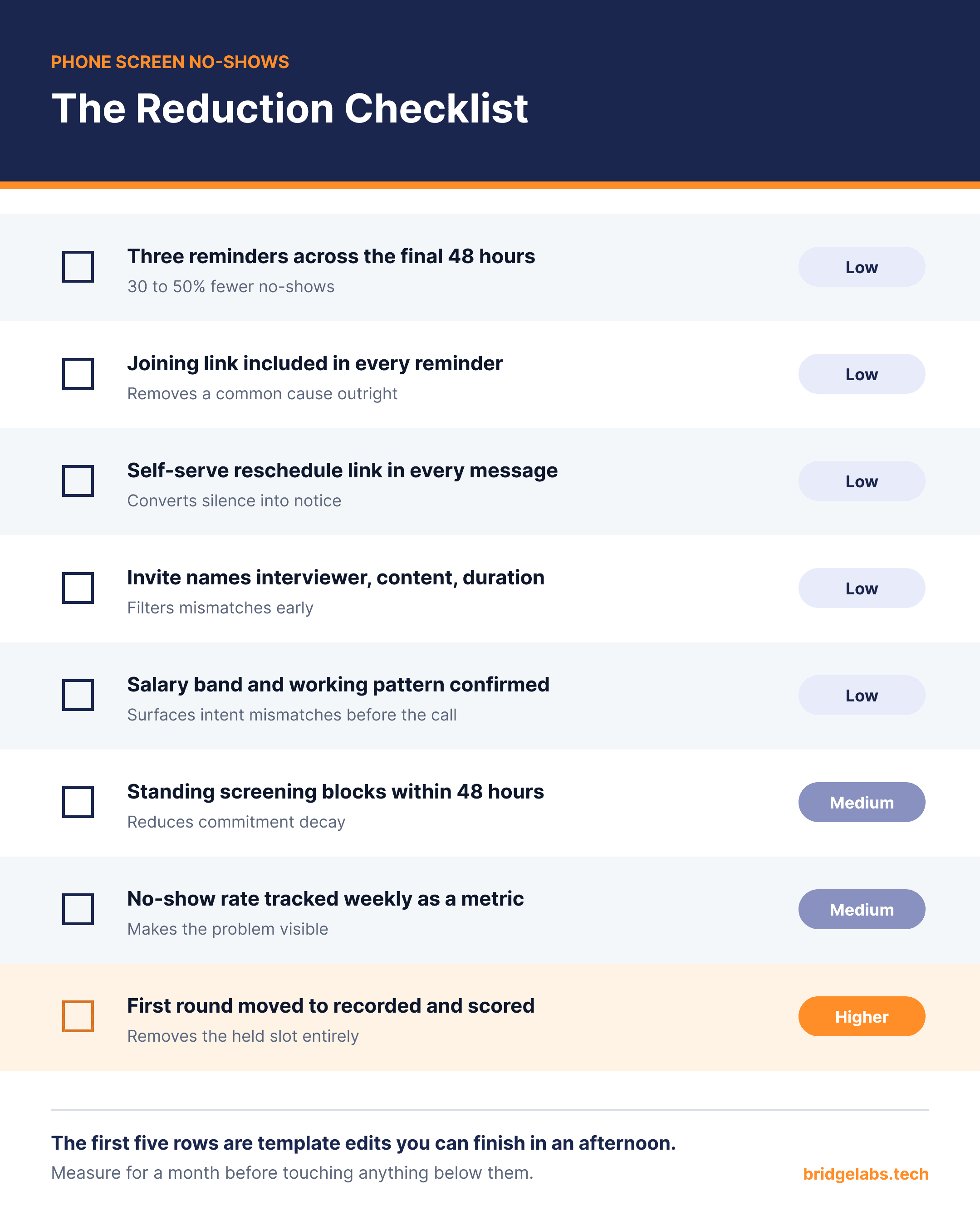
The No-Show Reduction Checklist

Work down this list in order, because the early items cost nothing and deliver most of the reduction.

noshow-reduction-checklist

FAQs

  1. What counts as a normal phone screen no-show rate?
    There is no single benchmark worth holding yourself against, because rates move with seniority, sourcing channel, market conditions, and how long your process takes. The number that matters is your own rate measured consistently over several months, since the trend tells you whether your changes worked, while a benchmark tells you very little.
  2. Should we call candidates who do not appear?
    One short message is worth sending, because a proportion of absences are genuine accidents, and those candidates often reschedule immediately. Beyond a single attempt, the recovery rate drops sharply, and the chasing time becomes part of the cost you are trying to reduce.
  3. Does moving to recorded screening hurt the candidate experience?
    It depends entirely on how the round is framed and how quickly you respond afterward. A recorded round with a clear deadline, a stated purpose, and a fast decision usually rates higher than a phone screen that took 9 days to arrange, though a fully automated process with no human contact at any stage rates lower than either.
  4. How quickly should we see the reduction after making these changes?
    The reminder cadence change shows up within two or three weeks because it affects every booking immediately. Shortening the booking-to-screen gap takes longer to show because it depends on restructuring how you block out your week.
Hiring process