8 AI Recruiting Workflows for Staffing Agencies
 Regine CyrilleHuman Resource10 Nov 2026
Most guidance on AI for staffing agencies is written for corporate talent teams and lightly relabeled. It assumes one employer, one requisition, one hiring manager, and a candidate relationship that ends at the offer.
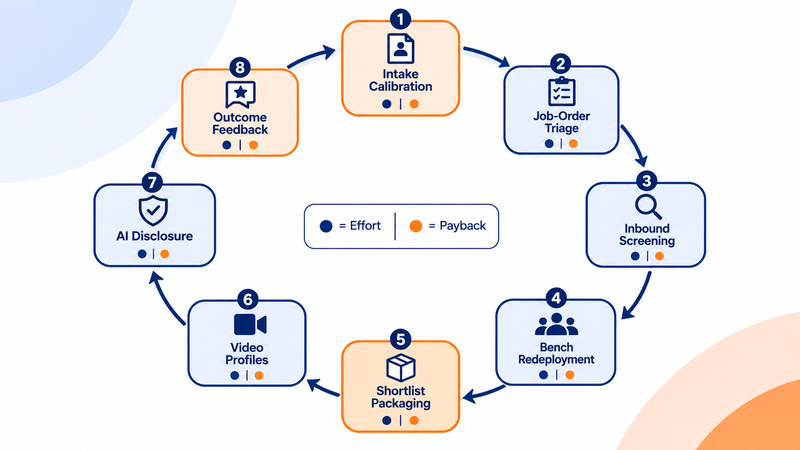
Agency work does not look like that. You are calibrating against a client's judgment rather than your own, packaging evidence for someone who never met the candidate, competing on speed to submit, and carrying a bench whose redeployment determines your margin. The buying decision that follows from all this is not "which AI screening tool" but "which of these eight repeated motions is worth automating first."
The right unit for this decision is not the tool. It is the workflow the tool sits inside.
What is actually pressing on agencies right now?
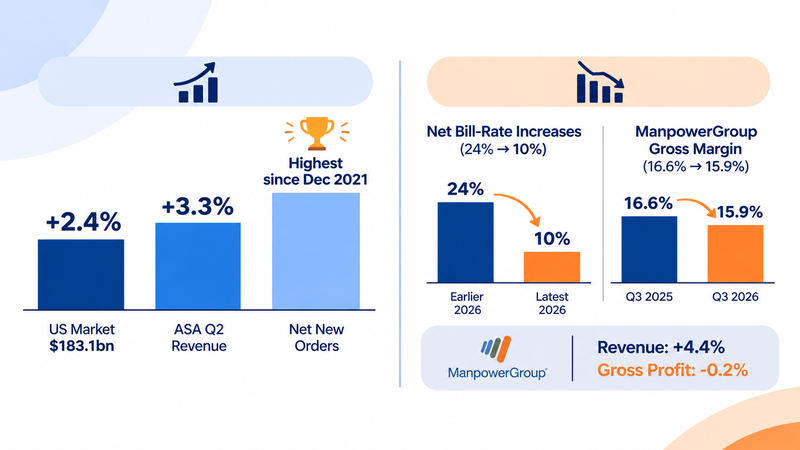
Volume came back this year. Staffing Industry Analysts raised its forecast in September to $183.1 billion for 2026, growing 2.4%, and the American Staffing Association reported second-quarter revenue up 3.3% year over year with employment up 0.6%, the first year-on-year growth after a weak first quarter.
The pricing did not come back with it. SIA's survey of 136 staffing firms found bill-rate momentum easing sharply, a net 10% reporting increases against 24% a month earlier, while net new orders hit their highest level since December 2021. More work, thinner spread.
That shows up in the filings. ManpowerGroup's third quarter grew revenue 4.4% while gross profit fell 0.2%, which puts gross margin at 15.9% against 16.6% a year earlier. Those percentages are arithmetic from the reported dollars, since the company does not publish the margin itself. Randstad grew organic revenue 3.9% over the same quarter but does not disclose gross margin in its release at all, so the public evidence of spread compression rests on ManpowerGroup and on the bill-rate survey above.
So the question is not how to find work. It is how to run more of it without adding cost, which is a workflow question before it is a software question.
1. Intake calibration: score the requisition with the client, in the meeting
The most expensive failure in agency work happens before any sourcing does, when your read of the role and the client's read differ by a margin nobody discovers until the third rejected submission.
The fix is to leave the intake call with a scored rubric rather than notes. Three to five must-haves, each with what evidence would satisfy it, agreed live. Where AI helps is drafting the rubric from the job description during the call so you are editing something concrete with the client rather than transcribing their answers.
This is also the artifact everything downstream depends on. Screening consistency, shortlist packaging and post-placement feedback all reference it, and none of them work if it does not exist.
Takeaway: end every intake call by reading the must-haves back and getting explicit agreement. Five minutes there removes most of your rework.
2. Job-order triage: decide which requisitions you actually work
Not every order should be worked, and the decision is usually made by whoever picks it up first rather than on merit.
Score incoming orders on the things that predict fill: exclusivity, how quickly the client has moved historically, whether the rate matches the market, and whether you already have relevant people on the bench. A simple weighted score applied consistently beats individual judgment applied inconsistently, particularly across a team where the strongest recruiters gravitate to the same easy orders.
This matters more in a recovering market than a weak one. With net new orders at a five-year high the constraint has moved from demand to your own capacity, and capacity spent on unwinnable orders is the most expensive thing on this list.
Takeaway: publish the triage criteria to the team. An unwritten prioritization rule becomes a seniority rule.
3. Inbound screening against the client's rubric, not yours
Screening at the top of an agency funnel is high volume and low judgment, which makes it the safest place to automate first and the place most firms start.
The discipline that matters is whose standard the tool applies. Screening against a generic quality bar produces candidates who are good and not what the client asked for. Screening against the rubric from workflow one produces submissions the client recognizes as responsive.
Bullhorn's industry survey of around 2,300 recruitment professionals found 55% of firms reporting KPI improvements above 25% from AI screening and 46% reporting screening time cut by half or better. Those are self-reported estimates from a vendor-run survey fielded in late 2025, so treat the magnitude skeptically and the direction as plausible.
Takeaway: configure screening per client, not per agency. A shared default rubric is how you end up submitting the same three people to everyone.
4. Bench redeployment before external sourcing
Every open order should be matched against your existing contractor base before a single job board spend is authorized. Most agencies believe they do this. Most do it when someone remembers.
The commercial case is unusually clean. A redeployed contractor has no sourcing cost, a known performance history, and a client reference already in hand. What there is no credible case for is any particular redeployment rate. A StaffingHub investigation in September traced the widely quoted benchmarks to their origins and found the circulating 6% figure came from a vendor blog in 2018 citing a 2014 guidebook, while the "best-in-class above 70%" and "industry average 30 to 40%" figures have no named source at all. Neither Bullhorn's GRID survey nor the ASA reports a redeployment rate.
So measure something that exists. Assignments per candidate and median days on your roster both have real denominators and both move when redeployment improves. Bullhorn's finding that 85% of firms with a redeployment plan place in under 20 days is worth knowing, but it describes firms that have a plan rather than a redeployment rate, and it should not be quoted as one.
Takeaway: trigger the bench match automatically on order creation, and report assignments per candidate rather than a redeployment percentage you cannot source.
5. Shortlist packaging: submit evidence, not resumes
What you send the client is your product. A forwarded resume with a two-line email asks the client to do the evaluation you were engaged to do.
A packaged shortlist states the rubric, shows how each candidate performs against each must-have with specific evidence, and names the trade-offs. Where a candidate is short on one requirement, say so and say what compensates. Clients discount packages that present every candidate as excellent, and they are right to.
Speed is why this matters commercially. A survey of 310 hiring leaders in manufacturing, logistics and construction found 77% had replaced an agency over speed and quality concerns, with 61% expecting roles filled within 48 hours. Vendor-sponsored, 2025, light industrial only, so do not generalize it to professional search.
Takeaway: put the rubric at the top of every submission. It converts the client's reply from an opinion into a decision against agreed criteria.
6. Video profile submission, used as evidence rather than as a filter
A short recorded introduction alongside the shortlist gives the client something a resume cannot: how the person explains their own work. For contract and volume roles it can remove an entire scheduling round.
The distinction that matters is between recording and scoring. Bullhorn's September research among candidates who had used recruitment firms found 69% had encountered AI through their firm and 81% of those rated it positively. The same quarter, Greenhouse found the most common reason candidates abandoned a process was a pre-recorded interview scored by AI with no human present, named by 33% of US respondents.
Both can be true, and the variable separating them is whether a person is visibly involved. In agency work that cost lands on you directly. A candidate who withdraws mid-process was your sourcing spend, and they stay in your database with an opinion of you.
Takeaway: use recorded profiles to shorten the client's process, not to replace your own screening judgment.
7. Decide your disclosure position, then apply it consistently
Most agencies are answering this by default rather than by decision, and the default is getting more expensive.
The pressure is not coming from where firms expect. There is no published MSP or VMS policy requiring suppliers to disclose AI use, no RFP standard and no trade body guidance. It is coming from candidates and from statute. iCIMS research published in October found 41% of candidates suspected undisclosed AI use against 32% who said it was clearly disclosed. Meanwhile New York City's Local Law 144 expressly covers employment agencies, California's FEHA regulations extend liability to agents acting on an employer's behalf, Illinois' draft rules reach recruiters and third parties, and Connecticut removed the use of an automated system as a defense to a discrimination claim from October 2026.
Agency readiness is behind that. A survey of 500 HR leaders at large staffing organizations found 78% use AI tools while only 25% have documented, actively enforced AI policies. Vendor-sponsored and undated on fieldwork, so read the gap rather than the decimals.
Takeaway: write one paragraph describing where AI sits in your process, put it in your standard terms, and have it ready before a client asks rather than after.
8. Close the loop: feed placement outcomes back into intake
The rubric from workflow one should be updated by what happened afterwards. Which must-haves predicted a successful placement, which were the client's preference rather than a requirement, and where did rejections cluster.
Almost no agency does this systematically, which is why intake calibration stays a personal skill rather than a firm-level asset. A structured note at 30 and 90 days on every placement, referenced at the next intake with that client, is the whole mechanism.
It is also your most defensible argument at renewal. With volume up and spread down, an agency that can show which criteria actually predicted performance in this client's roles is selling something a lower-cost competitor cannot match on price.
Takeaway: review the rubric against outcomes before every repeat intake with an existing client. That is the meeting where you stop being interchangeable.
How to Get Started
Take your last twenty submissions and mark each as accepted to interview or rejected. Then sort the rejections into two piles: candidates who did not meet the stated criteria, and candidates who met them and were rejected anyway.
The second pile is your intake calibration problem, and it is almost always larger than the first. That count tells you whether to start at workflow one or workflow three, and it is a better basis for a tooling decision than any vendor demo.
Then pick one client and run workflows one, five and eight properly for a quarter: a scored rubric agreed at intake, a packaged shortlist referencing it, and a structured outcome note at 90 days. Three workflows on one account will teach you more about what to automate than eight workflows attempted across the whole book.
FAQs
Should we tell clients we use AI in screening? Yes, in your standard terms rather than case by case. No client-side requirement exists yet, but candidate suspicion is running at 41% and the statutory notice duties arriving in 2027 will reach you through your clients whether or not they name you. An agency that has already documented its position looks like a managed supplier.
Are we a deployer or a developer under the new state AI laws? Unsettled, and worth asking counsel rather than guessing. An agency running a vendor's screening tool on its own candidates is most naturally a deployer, and that is where commentary puts the liability. Only New York City's law, California's FEHA regulations and Illinois' draft rules expressly reach agencies or agents, so the honest answer in most states is that nobody has decided yet.
out.
Where does AI pay back fastest in an agency? Inbound screening and bench matching, because both are high-frequency, rule-governed and currently done inconsistently. Intake calibration produces the largest improvement but depends on changing how recruiters run client meetings, which is a longer project.
Related Articles
Latest From Our Blog
Discover fresh insights, trends, and tips on tech talent and offshore development. Stay informed with our latest updates