How to Screen 100 Applicants in a Day: A 5-Stage Workflow | Bridge Labs
 Regine CyrilleHuman Resource04 Sept 2026
The standard approach to a hundred applicants is to block a day, start at the top of the list, and work down until it is done. Everyone gets a fair look, in order, from the same person.
It does not survive contact with the pile. Somewhere around applicant forty the reading gets faster, the standard drifts without anyone deciding to move it, and the last twenty get a treatment the first twenty would not recognize. The day ends with a shortlist nobody can reconstruct the logic of.
The problem with a hundred applicants is not that reading them takes too long. It is that nobody decided in advance what a no looks like.
Why does a day of screening no longer clear the pile?
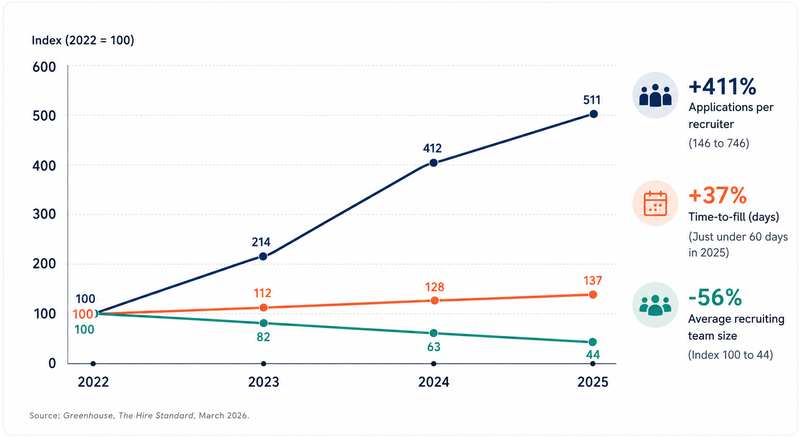
Volume moved faster than capacity did. Greenhouse, analyzing more than 640 million applications across 6,000 companies, found that applications per job posting reached 244 in 2025, up from 116 in 2022. Over the same period, applications per recruiter rose from 146 a year to 746, while the average recruiting team shrank by 56%.
Speed did not improve to match. Time-to-fill in the same dataset rose 37%, to just under 60 days. More applicants per role, fewer people to read them, and a slower process at the end of it.
The instinct is to read faster. That is the wrong lever, and it is worth knowing why. A study of 231,076 sequential professional judgments published in Communications Psychology in 2025 found no evidence that decision quality degrades across a long run of decisions. Reviewer fatigue is not what is failing.
What fails is that the cut points were never written down, so each decision gets made fresh, in isolation, against a standard held in someone's head.
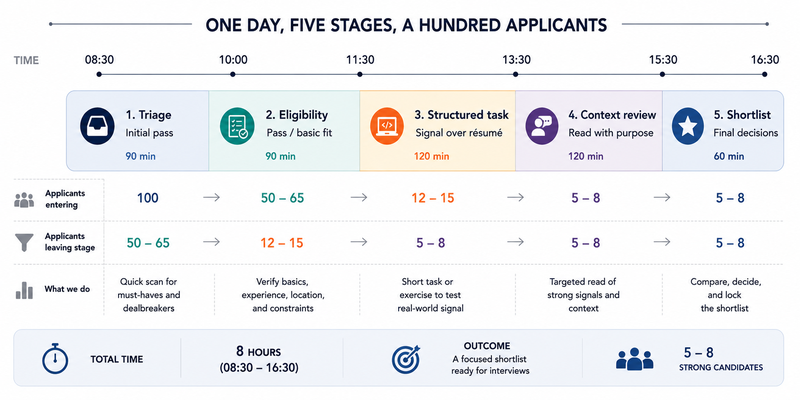
1. Set the three cuts before you open the pile (08:30-09:00)
Half an hour, before anyone reads a single application. Write down three things: what disqualifies someone mechanically, what puts someone on the shortlist immediately, and what happens to everyone in between.
The middle band is the one teams skip, and it is the one that consumes the day. Decide now whether the middle gets a second look, a structured task, or a rejection, and roughly how large you are willing to let it get. A middle band of sixty is not a decision you have made, it is one you have deferred a hundred times.
Write the criteria as observable facts, not qualities. "Has shipped a production service they can name" is checkable in fifteen seconds by two different people who will agree. "Strong technical background" is not, and it is where the standard drifts.
Takeaway: if you cannot write the disqualifying criteria in under thirty minutes, the role is not defined well enough to screen for yet.
2. Run the eligibility pass (09:00-10:15)
This stage is mechanical and should feel like it. Work rights, location, license or certification if the role legally requires one, and the two or three hard requirements you wrote down at 08:30. Nothing else.
No judgment calls here, which is what makes it fast: roughly 45 seconds per application, and it does not need your most experienced reviewer. On a hundred applicants this typically removes 35 to 50. Employers consistently report that a large share of job board applicants are not qualified, and iHire's 2025 survey of 529 employers put it at 59.7% saying they receive too many unqualified candidates.
Resist reading anything interesting in this pass. If someone fails a hard requirement but looks compelling, that is a signal your hard requirement is wrong. Note it, finish the pass, and change the criterion for the whole pile rather than making an exception for one person.
Takeaway: run this pass against the criteria only. Every exception you make here you will have to justify sixty applicants later.
3. Read for evidence, not impression (10:30-13:00)
The fifty or so survivors get a real read, against the two or three must-haves and nothing else. Two and a half hours, which is around three minutes each, and more time than most screening actually gets.
The six-second resume myth is worth retiring here. When Jan Tegze tracked 114 recruiters using session recording without telling them they were being timed, average review times came in at 17 to 46 seconds per resume, with a range from 12 seconds to nearly two and a half minutes. Nobody is deciding in six seconds. They are deciding in thirty, which is enough time to form an impression and not enough to check one.
The discipline that makes three minutes work is writing one line of evidence per must-have as you go. Not a rating. A quotation or a fact from the application. If you cannot find one, that is the finding, and it is faster to record than a score you will have to defend later.
Takeaway: a screening decision without a line of evidence attached is an impression. It will not survive a hiring manager asking why.
4. Send one structured task to the middle band (13:00-13:30)
Everyone you could argue either way about gets the same short structured step: the same three questions, the same time limit, the same format, sent in one batch in half an hour.
This is the move that changes the math of the day. Reading the middle band harder does not resolve it, because the ambiguity is in the evidence available, not in the attention you paid to it. Asking the same question of all of them generates new comparable evidence instead. It also converts your slowest, least consistent judgments into the format research supports most: the 2023 re-analysis of selection method validity by Sackett and colleagues puts structured interviews at .42 for predicting job performance against .19 for unstructured ones.
Send it, then leave it. Those responses are tomorrow's work, not today's.
Takeaway: the middle band is a question you have not asked yet, not a pile you have not read hard enough.
5. Calibrate the cut, then close the pile (15:30-16:30)
Take ten applications from either side of your shortlist line and have a second person score them blind against the same criteria. You are not looking for them to agree with you. You are looking for how often they do.
If two reviewers agree on eight or nine of ten, your cut is stable and the rest of the pile can stand. If they agree on five, the criteria are being read differently and the fix is to sharpen the wording for the whole pile, not for the disputed ten. This takes an hour and it is the only part of the day that tells you whether any of the rest of it was sound. It is also worth tracking over time rather than treating as a one-off check, because reviewer agreement is one of the six screening metrics worth measuring precisely: it determines whether every other number means anything.
Then close the pile deliberately. Some applications will not get a substantive review, and pretending otherwise is what produces the drifting standard in stage one. Decide the number, state it in your notes, and reject the remainder promptly and honestly rather than leaving them open for a month.
Takeaway: book the calibration check as a meeting with a second person. Alone, it does not happen.
Where to Start
Before your next high-volume role opens, take the last one you closed and reconstruct it. How many applications came in, how many got a real read, how many hours went in, and at what point in the list did the last shortlisted candidate appear?
That last number is the useful one. If your shortlist came entirely from the first thirty applications, you did not screen a hundred people. You screened thirty and rejected seventy by attrition. That is a defensible choice if you make it on purpose, and an indefensible one if it happens to you.
Then write the three cuts for the next role before it goes live, not on the morning the pile lands. Thirty minutes spent while nobody is waiting is worth three hours spent while a hundred people are.
Latest From Our Blog
Discover fresh insights, trends, and tips on tech talent and offshore development. Stay informed with our latest updates