Candidates Do Not Trust AI Interviews but Take Them Anyway
 Regine CyrilleTechnology03 Nov 2026
The usual framing treats candidate resistance as an obstacle to manage. Trust is low, the thinking goes, so the job is to reassure people until they come round to a format that is arriving whether they like it or not.
That framing survived until roughly the middle of this year. Then two things happened. Surveys kept finding that candidates distrust AI interviews, and the first large-scale studies of what candidates actually do when offered the choice found that most of them take the AI interview.
Those results are not a contradiction to be explained away because they are the most useful thing in the current evidence.
Candidates do not trust AI interviews. They take them anyway, and the reason they take them is the finding.
What changed in the evidence between May and October?
In May, Greenhouse published research across 2,950 job seekers in five markets reporting that 63% had faced an AI interview and 70% were never clearly told upfront that AI would evaluate them. Thirty-eight percent of US respondents said they had already withdrawn from a process because it included an AI interview.
In October, the same company published a follow-up across 2,800 job seekers that found only 7% would refuse an AI-led interview outright, and that candidates were 2.7 times more likely to opt for an AI interview than to withdraw when no human interviewer was available.
One caveat matters for reading both: Greenhouse completed its acquisition of a voice AI interview company in late May 2026, which means the pessimistic report landed just before it entered the category and the optimistic one well after.
Of course, neither is disqualified. The May findings were published against its own commercial interest, which is a point in their favor, and the October findings deserve the discount the May ones do not.
1. Every survey that asks the question finds trust is low
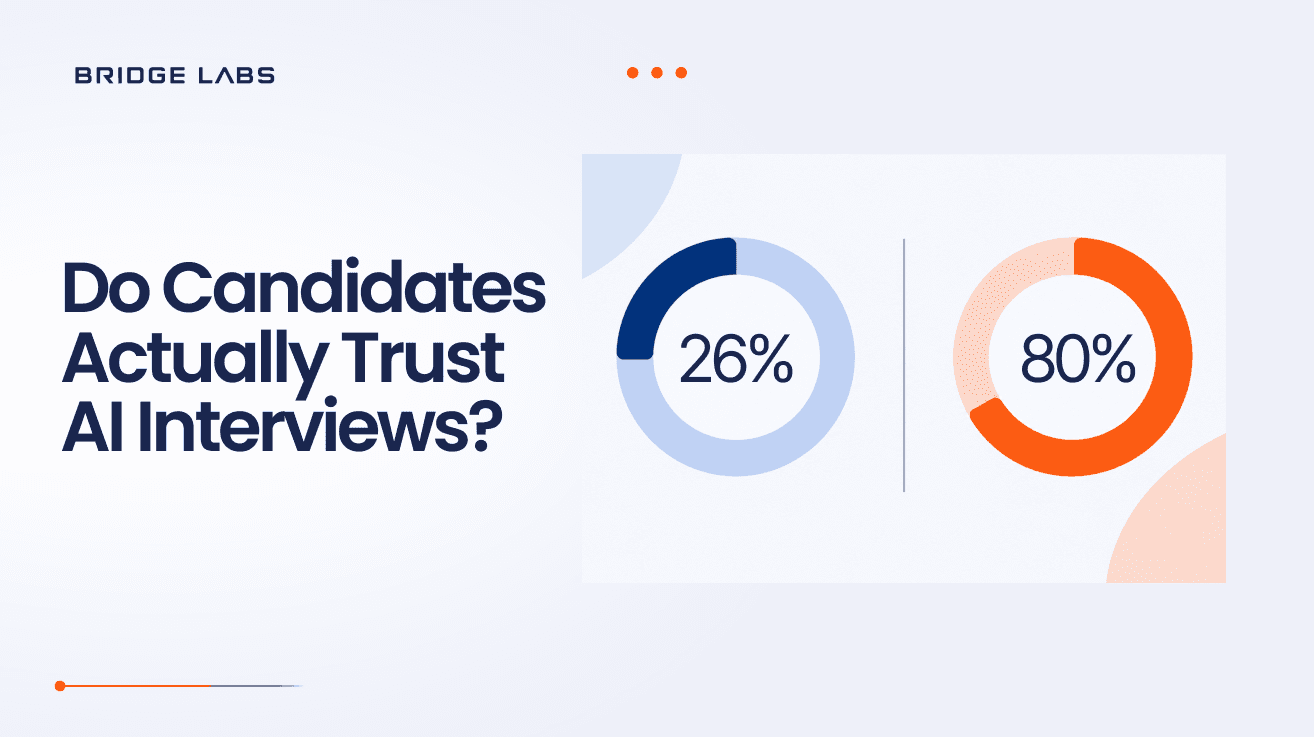
The anchor figure has not moved and has no successor. Gartner, surveying 2,918 job candidates, found that 26% trust AI will evaluate them fairly, with 25% saying they trust an employer less on learning AI is part of the evaluation.
New research puts it in the same region. iCIMS, surveying 1,000 US job seekers alongside 500 HR and talent leaders in research published on 29 October 2026, found 42% of candidates who believed AI had evaluated them were confident the screening was fair. Different question, different sample, broadly the same picture: a minority believe the process is fair to them.
Gartner is the better anchor of the two because it has no product in the category. iCIMS does, and its own report is the one that found the gap.
Key Insight: treat roughly one in three as your working estimate of candidates who believe the process is fair. Any communication plan built on a friendlier number is built on nothing.
2. Every study that watches behavior finds candidates opt in
This is the finding that was not available in the spring. Economists running a field experiment with a large outsourcing employer randomly assigned roughly 70,000 real applicants to a human or a voice AI interviewer. When candidates were given the choice, about 80% chose the AI interview. Those interviewed by AI were 12% more likely to receive an offer, with higher start rates and retention and no measured productivity loss.
Two caveats, and neither undoes it. This is a preprint rather than peer-reviewed work, and the roles were call-center positions at one employer, so it does not generalize cleanly to senior or specialized hiring. What it does provide is the thing survey research structurally cannot: what people choose when the choice is real and the job is real.
Stated preference and revealed preference are now pointing in opposite directions, and anyone citing only the survey half of that is quoting selectively.
Key Insight: stop treating survey distrust as a forecast of behavior. Measure your own completion rates and compare them to what candidates tell you in a feedback form.
3. What reconciles the two is the alternative on offer
The October research contains the mechanism. Candidates were markedly more willing to take an AI interview when no human interviewer was available, and the same study found that 81% had been rejected at least once in the past year without speaking to anyone at all, human or AI.
Reading against each other, those numbers stop looking like enthusiasm. A candidate choosing an AI interview over nothing is not endorsing AI interviews. They are choosing to be assessed over being ignored, which is a much lower bar than most vendor messaging claims.
That also explains why the withdrawal figures and the opt-in figures can both be true. Offered as a replacement for a human conversation, an AI stage loses people. Offered as an alternative to silence, it keeps them.
Key Insight: the honest comparison is not AI interview against human interview. It is AI interview against the rejection email your process would otherwise have sent.
4. The disclosure gap is the one finding that holds across every study
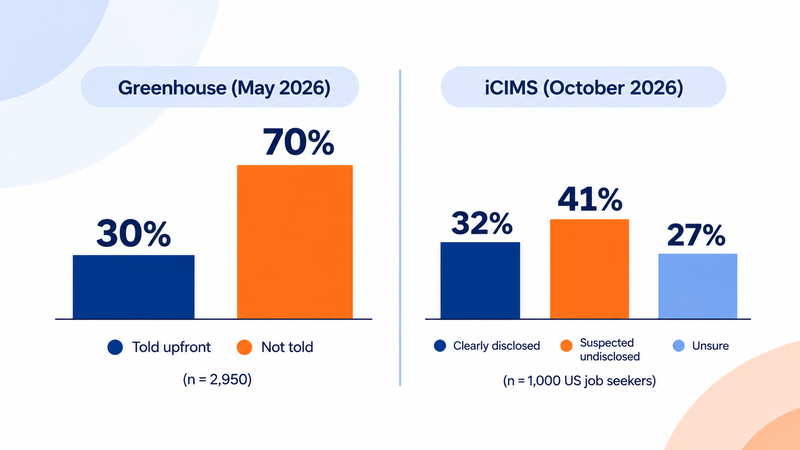
Everything else in this evidence base moves. Disclosure does not. Greenhouse's May research found 70% were never clearly told upfront. The iCIMS research in October found 32% said employers clearly disclosed AI involvement, while 41% suspected undisclosed use.
What is new is that the law is catching up. Illinois has required notice since January 2026. Connecticut's Public Act 26-15 removed the use of an automated system as a defense to a discrimination claim from 1 October 2026, with pre-decision written notice duties following in October 2027. Colorado's replacement AI statute requires pre-use notice from January 2027. In the EU, the high-risk obligations covering recruitment were deferred to December 2027, but the Article 50 duty to tell people they are interacting with an AI system took effect in August 2026 and was not deferred.
Key Insight: write the disclosure sentence now. Within eighteen months, it stops being a courtesy in most jurisdictions where you hire.
5. Candidates do not think AI is more biased; they think it is less accountable
Greenhouse asked candidates whether they felt judged unfairly on particular characteristics, separately for AI and human interviewers. The rates came back almost identical. Thirty-six percent felt judged on age in both cases and 27% on race or ethnicity in both. The only gap favored AI: 21% felt judged on appearance by AI, compared with 28% by humans.
And yet 54% still preferred a human interviewer and only 17% trusted AI more. If perceived bias is roughly constant, the preference is being driven by something else. A person can be asked why. A scoring model cannot, and in most processes nobody is designated to answer on its behalf.
This is why the accountability argument outperforms the fairness argument. Telling candidates your system is less biased than your interviewers invites a comparison they do not find reassuring. Telling them who reviewed the result and how to reach that person answers the question they are actually asking.
Key Insight: put a named human in the rejection email from an AI-assisted stage. That one change addresses the preference the bias data cannot explain.
6. What candidates ask for is cheap, specific, and increasingly statutory
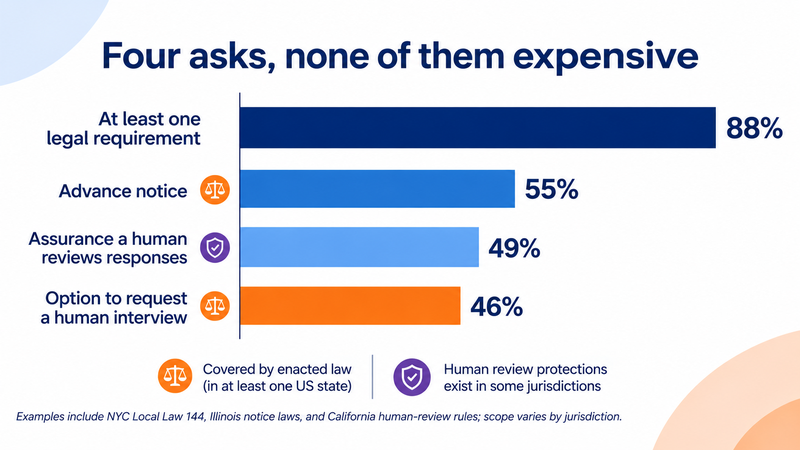
Asked what would make an AI-assisted process acceptable, candidates name the same handful of things across every study. In the October research, 88% wanted at least one legal requirement on AI in interviews, 55% wanted advance notice, and 49% wanted assurance that a human reviews responses.
Survey work among front-line workers published in July 2026 points the same way. Roughly half were more comfortable with AI in hiring when they knew a person reviewed the final decision, 42% wanted a human reachable at any point, and close to three in four said their trust in an organization was shaped directly by how it explained its AI use. That research was commissioned by a hiring technology vendor and covers front-line roles only, so read the direction rather than the decimals.
None of these asks requires a different tool. They require a sentence, a named reviewer, and a route back to a person.
Key Insight: publish what the AI measures and who reviews it. Those two disclosures cover the top asks in every study cited here.
How to Get Started
Going through your own interview invitation as though you did not already know how your process works: Does it say whether AI is involved, what it looks at, who reviews the result, and how to ask for something different?
Most invitations answer none of those, and rewriting one email addresses the only finding in this evidence base that every study agrees on.
Then measure completion at your most automated stage, separated from every other stage, and ask the people who finish it one question about whether the process felt fair. You will then have both halves of the picture this research keeps splitting apart: what your candidates do, and what they say about it.
The gap between those two numbers is more useful than anyone else's survey, including all of the above.
Latest From Our Blog
Discover fresh insights, trends, and tips on tech talent and offshore development. Stay informed with our latest updates